Chapter 11 · Class 10 CBSE
Areas Related to Circles 2-Mark Questions Class 10: CBSE PYQs with Answers
Choose the boundary or region first, then use the matching circle formula. Practise selected two-mark questions on sectors, segments, clock hands and shaded regions, with both alternatives of original OR pairs solved.
28 question groups · 43 worked answers · 15 OR pairs · 36 board-paper and 6 official-sample appearances
Key results
| What you need | Starting relationship |
|---|---|
| Sector area | (θ/360) × πr² |
| Arc length | (θ/360) × 2πr |
| Sector perimeter | Arc length + 2r |
| Sector area from arc length l | () × r × l |
| Minor segment area | Minor sector area − triangle area |
| Major segment area | Circle area − minor segment area |
| Minute-hand movement | 6° per minute |
Showing 28 question groups
Questions on this page · Show / hide list
Sectors, arcs and clock hands
- Question 1 · OR pair
- Question 2
- Question 3
- Question 4 · OR pair
- Question 5
- Question 6
- Question 7 · OR pair
- Question 8
Minor and major segments
- Question 9
- Question 10 · OR pair
- Question 11 · OR pair
- Question 12 · OR pair
- Question 13 · OR pair
- Question 14 · OR pair
Shaded and combined regions
- Question 15
- Question 16 · OR pair
- Question 17
- Question 18
- Question 19 · OR pair
- Question 20 · OR pair
- Question 21 · OR pair
Perimeters and circle measurements
- Question 22
- Question 23 · OR pair
- Question 24
- Question 25
- Question 26 · OR pair
- Question 27
- Question 28 · OR pair
Sectors, arcs and clock hands
Q1.(a) The length of an arc of a circle of radius 18 cm is 10π cm. Find the angle subtended by this arc at the centre of the circle.
Show answer and solution
10π = (θ/360) × 2π × 18
θ = 100°
Answer: 100°
OR
(b) The diameter of a wheel of a bus is 140 cm. Find the number of revolutions the wheel will make in one minute to keep the speed of the bus at 66 km/h.
Show answer and solution
Distance in one minute = 66 × 1000 / 60 = 1100 m = 110000 cm
Wheel circumference = () × 140 = 440 cm
Number of revolutions = = 250
Answer: 250 revolutions
Appeared in: 2023 · Basic · Main
Q2.The length of the minute-hand of a clock is 14 cm. Find the area swept by the minute-hand in 20 minutes.
Show answer and solution
Angle = () × 20 = 120°
Area = () × () × 14² = cm²
Answer: cm² (approximately 205.33 cm²)
Appeared in: 2023 · Standard · Main
Q3.A horse, a cow and a goat are tied, each by ropes of length 14 m, at the corners A, B and C respectively, of a grassy triangular field ABC with sides of lengths 35 m, 40 m and 50 m. Find the total area of grass field that can be grazed by them.
Show answer and solution
The three corner sectors each have radius 14 m; their angles add to 180°.
The sectors do not overlap: each side is greater than 14 + 14 = 28 m.
Total area = () × () × 14² = 308 m²
Answer: 308 m²
Appeared in: 2024 · Standard · Main
Q4.(a) The minute hand of a clock is 14 cm long. Find the area on the face of the clock described by the minute hand in 5 minutes.
Show answer and solution
Angle = () × 5 = 30°
Area = () × () × 14² = cm²
Answer: cm² (approximately 51.33 cm²)
OR
(b) Find the length of the arc of a circle which subtends an angle of 60° at the centre of the circle of radius 42 cm.
Show answer and solution
Arc length = () × 2 × () × 42 = 44 cm
Answer: 44 cm
Appeared in: 2024 · Standard · Main
Q5.The length of the minute hand of a wall clock is 21 cm. Find the area swept by the minute hand in 45 minutes.
Show answer and solution
Angle = () × 45 = 270°
Area = () × () × 21² = 1039.5 cm²
Answer: 1039.5 cm²
Appeared in: 2024 · Standard · Supplementary
Q6.The length of the minute hand of a clock is 4·2 cm. Find the area swept by the minute hand in 5 minutes.
Show answer and solution
Angle swept in 5 minutes = () × 360° = 30°.
Area = () × () × 4.2 × 4.2 = 4.62 cm².
Answer: 4.62 cm²
Appeared in: 2026 · Standard · Second board examination
Q7.(a) The length of the minute hand of a clock is 6 cm. Find the area swept by it when it moves from 7:05 p.m. to 7:40 p.m.
Show answer and solution
Elapsed time = 35 minutes.
Angle swept = () × 360° = 210°.
Area swept = () × π × 6².
Using π = , area = 66 cm².
Answer: 66 cm²
OR
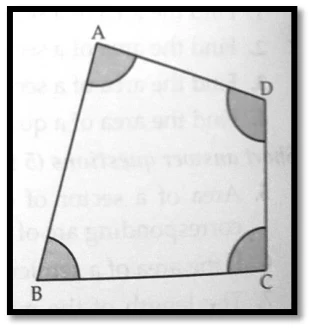
(b) In the given figure, arcs have been drawn of radius 7 cm each with vertices A, B, C and D of quadrilateral ABCD as centres. Find the area of the shaded region.
Show answer and solution
Let the interior angles of ABCD be A, B, C and D.
A + B + C + D = 360°.
Total shaded area = [(A + B + C + D)/360] × π × 7².
= π × 49 = 154 cm², using π = 22/7.
Answer: 154 cm²
Appeared in: 2022–23 · Standard · Official sample
Q8.Find the area of a sector of a circle with diameter 28 cm, if the length of the corresponding arc is 22 cm.
Show answer and solution
Radius r = = 14 cm; arc length l = 22 cm.
Sector area = () × r × l.
= () × 14 × 22 = 154 cm².
Answer: 154 cm²
Appeared in: 2026–27 · Standard · Official sample
Minor and major segments
Q9.A chord of a circle of diameter 20 cm subtends an angle of 60° at the centre of the circle. Find the area of the corresponding minor segment of the circle. (Use π = 3·14 and √3 = 1·73)
Show answer and solution
Radius r = = 10 cm.
The central angle is 60°, so the triangle formed by the chord and radii is equilateral.
Sector area = () × 3.14 × 10² = cm².
Triangle area = () × 10² = cm², using √3 = 1.73.
Minor segment area = sector area − triangle area.
= − = cm² ≈ 9.08 cm².
Answer: cm² ≈ 9.08 cm²
Appeared in: 2025 · Basic · Main
Q10.(a) A chord of a circle of radius 14 cm subtends a right angle at the centre. Find the area of the minor segment.
Show answer and solution
Area = () × () × 14² − () × 14² = 154 − 98.
Answer: 56 cm²
OR
(b) The perimeter of a sector of a circle of radius 21 cm is 75 cm. Find the area of the sector.
Show answer and solution
Arc length = 75 − 2 × 21 = 33 cm.
Area of sector = () × r × arc length = () × 21 × 33.
Answer: 346.5 cm²
Appeared in: 2025 · Standard · Main
Q11.(a) A chord AB of a circle of radius 14 cm makes a right angle at the centre of the circle. Find the area of the minor segment.
Show answer and solution
Area of 90° sector = () × () × 14² = 154 cm².
Area of triangle AOB = () × 14 × 14 = 98 cm².
Area of minor segment = 154 − 98 = 56 cm².
Answer: 56 cm²
OR
(b) An arc of length 22 cm subtends an angle of 60° at the centre of the circle. Find the area of the sector of the circle made by the arc.
Show answer and solution
22 = () × 2 × () × r, so r = 21 cm.
Area = () × () × 21² = 231 cm².
Answer: 231 cm²
Appeared in: 2026 · Standard · Main
Q12.(a) The perimeter of a sector of circle of radius 5·6 cm is 27·2 cm. Find the area of the sector.
Show answer and solution
Arc length = 27.2 − 2 × 5.6 = 16 cm.
Area of sector = () × radius × arc length = () × 5.6 × 16 = 44.8 cm².
Answer: 44.8 cm²
OR
(b) A chord of length 10 cm is drawn in a circle of radius 5√2 cm. Find the area of the minor segment of the circle. (Use π = 3·14)
Show answer and solution
The two radii have length 5√2 cm.
10² = (5√2)² + (5√2)², so the central angle is 90° by the converse of Pythagoras.
Sector area = () × 3.14 × (5√2)² = 39.25 cm².
Triangle area = () × (5√2)² = 25 cm².
Minor segment area = 39.25 − 25 = 14.25 cm².
Answer: 14.25 cm²
Appeared in: 2026 · Basic · Second board examination
Q13.(a) Find the diameter of a circle whose area is equal to the sum of the areas of two circles of radii 40 cm and 9 cm.
Show answer and solution
Let R be the radius of the required circle.
πR² = π × 40² + π × 9².
R² = 1600 + 81 = 1681, so R = 41 cm.
Diameter = 2R = 82 cm.
Answer: 82 cm
OR
(b) A chord of a circle of radius 10 cm subtends a right angle at the centre. Find the area of minor segment. (Use π = 3.14)
Show answer and solution
Area of the 90° sector = () × 3.14 × 10² = 78.5 cm².
The two radii are perpendicular, so the triangle area = () × 10 × 10 = 50 cm².
Area of the minor segment = sector area − triangle area.
= 78.5 − 50 = 28.5 cm².
Answer: 28.5 cm²
Appeared in: 2023–24 · Basic · Official sample
Q14.(a) A horse, a cow and a goat are tied, each by ropes of length 14 m, at the corners A, B and C respectively, of a grassy triangular field ABC with sides of lengths 35 m, 40 m and 50 m. Find the area of grass field that can be grazed by them.
Show answer and solution
The grazed parts are three sectors of radius 14 m at the triangle vertices.
The sectors do not overlap: each side is greater than 14 + 14 = 28 m.
The three sector angles add to 180°.
Total grazed area = () × π × 14².
= () × () × 196 = 308 m².
Answer: 308 m²
OR
(b) Find the area of the major segment (in terms of π) of a circle of radius 5 cm, formed by a chord subtending an angle of 90° at the centre.
Show answer and solution
Area of the minor sector = () × π × 5² = 25π/4 cm².
The radii are perpendicular, so triangle area = () × 5 × 5 = cm².
Minor segment area = (25π/4 − ) cm².
Major segment area = circle area − minor segment area.
= 25π − (25π/4 − ) = (75π/4 + ) cm².
Answer: (75π/4 + ) cm²
Appeared in: 2025–26 · Standard · Official sample
Shaded and combined regions
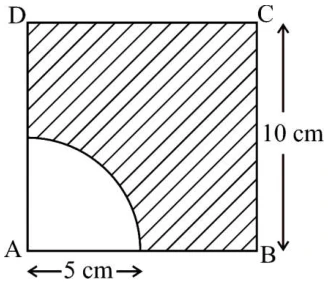
Q15.In the given figure, ABCD is a square of side 10 cm. A sector of radius 5 cm is cut out from one of the corners. Find the area of the shaded region. (Take π = 3.14)
Show answer and solution
The figure shows a quadrant centred at A, with radius 5 cm.
Area = 10² − () × 3.14 × 5² = 100 − 19.625 = 80.375 cm² ≈ 80.38 cm²
Answer: 80.375 cm² ≈ 80.38 cm²
Appeared in: 2024 · Basic · Supplementary
Q16.(a) A chord is subtending an angle of 90° at the centre of a circle of radius 14 cm. Find the area of the corresponding minor segment of the circle.
Show answer and solution
Area of sector = () × () × 14² = 154 cm²
Area of triangle = () × 14² = 98 cm²
Minor segment = 154 − 98 = 56 cm²
Answer: 56 cm²
OR
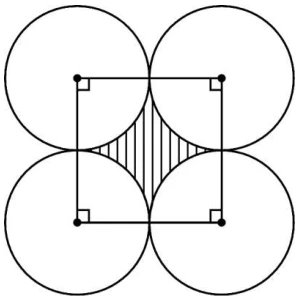
(b) Find the area of the shaded region if length of radius of each circle is 7 cm. Each circle touches the other two externally.
Show answer and solution
The figure shows four circles centred at the four corners of a square of side 14 cm.
Shaded area = 14² − 4 × () × () × 7² = 196 − 154 = 42 cm²
Answer: 42 cm²
Appeared in: 2024 · Standard · Supplementary
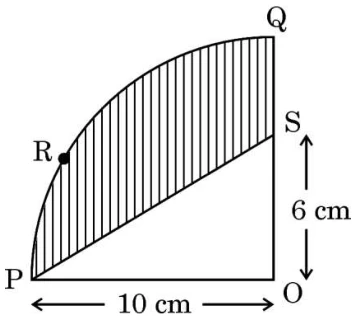
Q17.In the given figure, OPRQ is a quadrant of a circle with centre O and radius 10 cm. If OP = 10 cm and OS = 6 cm, find the area of the shaded region. (Use π = 3·14)
Show answer and solution
Shaded area = area of quadrant OPRQ − area of triangle POS.
Area = () × 3.14 × 10² − () × 10 × 6 = 78.5 − 30.
Answer: 48.5 cm²
Appeared in: 2025 · Basic · Main
Q18.From a circular sheet of radius 70 cm, a quadrant is cut. Find the area of the remaining sheet.
Show answer and solution
Remaining area = πr² − ()πr² = ()πr².
Area = () × () × 70² = 11550 cm².
Answer: 11550 cm²
Appeared in: 2025 · Basic · Main
Q19.(a) The perimeter of a sector of a circle of radius 15 cm is 80 cm. Find the area of the sector.
Show answer and solution
Arc length l = 80 − 2 × 15 = 50 cm.
Area = ()rl = () × 15 × 50.
Answer: 375 cm²
OR
(b) In the given figure, ABCD is a trapezium with AB ∥ DC. Find the area of the shaded region. (Keep the answer in terms of π).
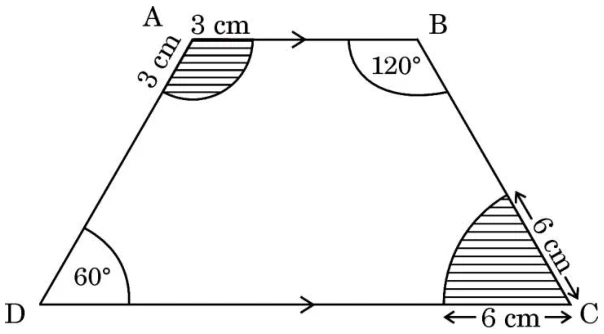
Show answer and solution
Since AB ∥ DC, ∠A = 180° − 60° = 120° and ∠C = 180° − 120° = 60°.
Shaded area = ()π × 3² + ()π × 6² = 3π + 6π.
Answer: 9π cm²
Appeared in: 2025 · Standard · Supplementary
Q20.(a) In the figure, find the area of the shaded region. (Take π = 3.14)
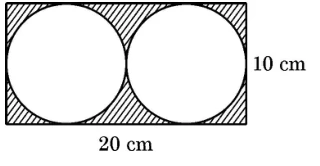
Show answer and solution
Each circle has radius = 5 cm.
Shaded area = rectangle area − 2 × circle area = 20 × 10 − 2 × 3.14 × 5² = 43 cm².
Answer: 43 cm²
OR
(b) Find the radius of the circle whose one sector has area of 66 sq. cm. and the length of its arc is 22 cm.
Show answer and solution
Area of sector = () × radius × arc length.
66 = () × r × 22, so r = 6 cm.
Answer: 6 cm
Appeared in: 2026 · Standard · Second board examination
Q21.(a) With vertices A, B and C of ΔABC as centres, arcs are drawn with radii 14 cm and the three portions of the triangle so obtained are removed. Find the total area removed from the triangle.
Show answer and solution
The three sector angles are A, B and C, with A + B + C = 180°.
Total removed area = [(A + B + C)/360] × π × 14².
= () × () × 196 = 308 cm².
Answer: 308 cm²
OR
(b) Find the area of the unshaded region shown in the given figure.
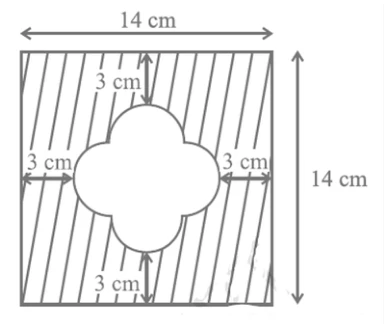
Show answer and solution
The horizontal and vertical extent of the white region is 14 − 3 − 3 = 8 cm.
Let a be the side of its central square. Each semicircle has diameter a.
Total width = a/2 + a + a/2 = 2a, so a = 4 cm.
The semicircle radius is 2 cm.
Unshaded area = square area + four semicircle areas.
= 4² + 4 × () × π × 2² = (16 + 8π) cm².
Answer: (16 + 8π) cm²
Appeared in: 2023–24 · Standard · Official sample
Perimeters and circle measurements
Q22.In the given figure, two concentric circles with centre O and radii 2 cm and 3 cm are shown. Find the perimeter of the shaded region.
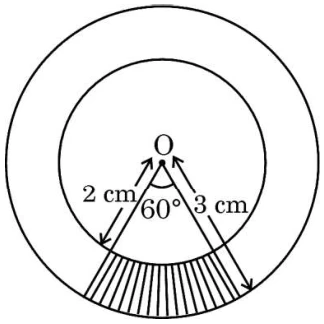
Show answer and solution
The figure shades the annular sector with central angle 60°.
Perimeter = () × 2π × 3 + () × 2π × 2 + 2(3 − 2) = 5π/3 + 2.
Using π = , perimeter = cm.
Answer: cm ≈ 7.24 cm
Appeared in: 2025 · Basic · Main
Q23.(a) The area of a smaller circle is equal to the area of a sector of a larger circle with central angle 120°. The radii of the smaller and larger circles are ‘r’ and ‘R’ respectively. Find r : R.
Show answer and solution
πr² = ()πR², so r²/R² = 1/3.
Taking positive square roots, r : R = 1 : √3.
Answer: 1 : √3
OR
(b) In the given figure, O is the centre of a circle of radius 7 cm. AB is a chord of the circle. Find the perimeter of the shaded region.
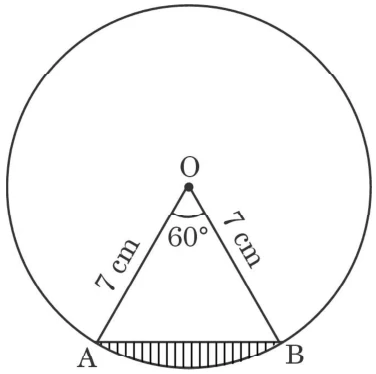
Show answer and solution
From the figure ∠AOB = 60°, so triangle AOB is equilateral and AB = 7 cm.
Length of minor arc AB = () × 2 × () × 7 = cm.
Perimeter of shaded minor segment = arc AB + chord AB = + 7 = cm.
Answer: cm ≈ 14.33 cm
Appeared in: 2025 · Basic · Main
Q24.In the given figure, OABC is a quadrant of a circle with centre O and radius 8 cm. If OD = 6 cm, then find then perimeter of the shaded region.
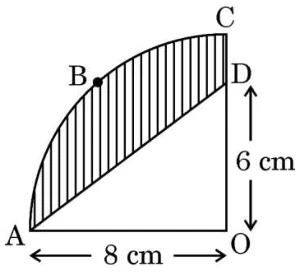
Show answer and solution
AD = √(OA² + OD²) = √(8² + 6²) = 10 cm; CD = 8 − 6 = 2 cm.
Arc ABC = () × 2 × () × 8 = cm.
Perimeter = arc ABC + AD + CD = + 10 + 2 = cm.
Answer: cm ≈ 24.57 cm
Appeared in: 2025 · Basic · Main
Q25.From a circular sheet of radius 10 cm, a quadrant is cut. Find the perimeter of the remaining sheet.
Show answer and solution
Perimeter = remaining 270° arc + two radii = () × 2πr + 2r.
With r = 10 and π = , perimeter = + 20 = cm.
Answer: cm ≈ 67.14 cm
Appeared in: 2025 · Basic · Main
Q26.(a) In the given figure, the shape of the top of a table is that of a sector of a circle with centre O and ∠AOB = 90°. If AO = OB = 42 cm, then find the perimeter of the top of the table.
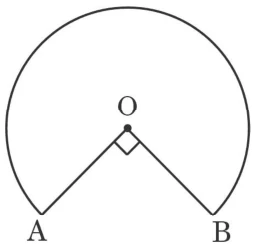
Show answer and solution
The figure shows the major sector: its arc subtends the reflex angle 360° − 90° = 270°.
Perimeter = () × 2 × () × 42 + 2 × 42 = 198 + 84.
Answer: 282 cm
OR
(b) In the given figure, three sectors of a circle of radius 5 cm, making angles 35°, 50° and 95° at the centre are shaded. Find the area of the shaded region. [Use π = ]
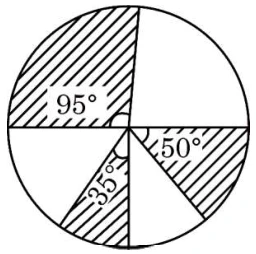
Show answer and solution
Total shaded angle = 35° + 50° + 95° = 180°.
Area = () × () × 5² = cm².
Answer: cm² ≈ 39.29 cm²
Appeared in: 2025 · Standard · Main
Q27.A wire when bent in the form of an equilateral triangle encloses an area of 121√3 cm². The same wire is bent into the form of a circle. Find the area enclosed by the circle.
Show answer and solution
()a² = 121√3, so a = 22 cm. Wire length = 3a = 66 cm.
2πr = 66 ⇒ r = 10.5 cm, using π = 22/7.
Area of circle = () × 10.5².
Answer: 346.5 cm²
Appeared in: 2025 · Basic · Supplementary
Q28.(a) Find the perimeter of a quadrant of a circle of radius 14 cm.
Show answer and solution
Perimeter = two radii + arc length.
= 2r + () × 2πr.
= 2 × 14 + () × 2 × () × 14.
= 28 + 22 = 50 cm.
Answer: 50 cm
OR
(b) Find the diameter of a circle whose area is equal to the sum of the areas of the two circles of radii 24 cm and 7 cm.
Show answer and solution
Let R be the radius of the required circle.
πR² = π × 24² + π × 7².
R² = 576 + 49 = 625, so R = 25 cm.
Diameter = 2R = 50 cm.
Answer: 50 cm
Appeared in: 2022–23 · Basic · Official sample
Questions students ask
What is the difference between arc length and sector perimeter?
An arc is only the curved boundary. A sector also has two straight radii, so its perimeter is arc length + 2r. Trace the entire boundary before substituting into a formula.
How do I find the area of a minor segment?
Find the area of the sector bounded by the chord’s endpoints and the centre, then subtract the area of the triangle formed by the two radii and the chord. For a 90° central angle, the triangle area is ()r².
How do I find the area of a major segment?
Find the corresponding minor segment first. Subtract it from πr² to obtain the major segment. Do not confuse a major segment with a major sector: their straight boundaries are different.
How do I find the angle swept by a clock’s minute hand?
The minute hand turns through 360° in 60 minutes, so it moves 6° per minute. Multiply the elapsed minutes by 6°, then use that angle and the hand’s length in the sector-area formula.
Which value of π should I use?
Use the value printed in the question. If the paper gives a general instruction such as π = , follow it where no different value is stated. If the answer is requested in terms of π, retain π in the final expression.
Why can’t I use the marked angle for every sector in a diagram?
A marked angle may describe the smaller sector while the required region uses the larger arc. Identify the requested region and use 360° minus the marked angle when it represents the complementary major sector.
What changes when a quadrant is cut from a circular sheet?
For the remaining area, subtract one-quarter of the circle’s area. For the remaining perimeter, add the two exposed radii to the three-quarter circular arc. Area and perimeter therefore need different calculations.
Should I round the radius before finding an area?
Keep exact fractions or surds during the working wherever possible and round only the final answer. Use any prescribed value of π or √3 consistently, and write square units for areas and length units for perimeters.
How to write a two-mark solution
- Identify the required region or trace the full boundary.
- Write the appropriate formula and substitute the given values.
- Simplify and give the final answer with the correct unit.
Answer summary · 43 worked answers
| Question | Answer |
|---|---|
| Q1 (a) | 100° |
| Q1 (b) | 250 revolutions |
| Q2 | cm² (approximately 205.33 cm²) |
| Q3 | 308 m² |
| Q4 (a) | cm² (approximately 51.33 cm²) |
| Q4 (b) | 44 cm |
| Q5 | 1039.5 cm² |
| Q6 | 4.62 cm² |
| Q7 (a) | 66 cm² |
| Q7 (b) | 154 cm² |
| Q8 | 154 cm² |
| Q9 | cm² ≈ 9.08 cm² |
| Q10 (a) | 56 cm² |
| Q10 (b) | 346.5 cm² |
| Q11 (a) | 56 cm² |
| Q11 (b) | 231 cm² |
| Q12 (a) | 44.8 cm² |
| Q12 (b) | 14.25 cm² |
| Q13 (a) | 82 cm |
| Q13 (b) | 28.5 cm² |
| Q14 (a) | 308 m² |
| Q14 (b) | (75π/4 + ) cm² |
| Q15 | 80.375 cm² ≈ 80.38 cm² |
| Q16 (a) | 56 cm² |
| Q16 (b) | 42 cm² |
| Q17 | 48.5 cm² |
| Q18 | 11550 cm² |
| Q19 (a) | 375 cm² |
| Q19 (b) | 9π cm² |
| Q20 (a) | 43 cm² |
| Q20 (b) | 6 cm |
| Q21 (a) | 308 cm² |
| Q21 (b) | (16 + 8π) cm² |
| Q22 | cm ≈ 7.24 cm |
| Q23 (a) | 1 : √3 |
| Q23 (b) | cm ≈ 14.33 cm |
| Q24 | cm ≈ 24.57 cm |
| Q25 | cm ≈ 67.14 cm |
| Q26 (a) | 282 cm |
| Q26 (b) | cm² ≈ 39.29 cm² |
| Q27 | 346.5 cm² |
| Q28 (a) | 50 cm |
| Q28 (b) | 50 cm |
About these questions and solutions
Selected official CBSE two-mark questions with TutorVertex solutions in NCERT-style steps, checked against the cited marking schemes.
Repeated full groups are merged; original OR pairs stay together, with both alternatives solved for practice.
Official sources and question details
Page references count from the first page of each PDF. Appearance labels beneath questions remain plain text.
Question 1 sources
2023 · Basic · Main · 430/B · Q24
Official Question paper · PDF pp. 15
MATHEMATICS_BASIC/430_B_Maths Basic for VI candidates.pdf
Official Marking scheme · PDF pp. 8, 9
Math_Basic/430_VISUALLY IMPAIRED MATHEMATICS BASIC FINAL.pdf
Question 2 sources
2023 · Standard · Main · 30/B/5 · Q25
Official Question paper · PDF pp. 15
MATHEMATICS_STANDARD/30_B_5_Maths Std. for VI candidates.pdf
Official Marking scheme · PDF pp. 10
Maths_Standard/MS 041_30(B) Mathematics 2022-23.pdf
Question 3 sources
2024 · Standard · Main · 30/B · Q25
Official Question paper · PDF pp. 13
MATHEMATICS_STANDARD/30(B) Mathematics.pdf
Official Marking scheme · PDF pp. 10
Mathematics_Standard/MS 041_30(B) Mathematics 2023-24.pdf
Question 4 sources
2024 · Standard · Main · 30/4/1 · Q22
Official Question paper · PDF pp. 11
MATHEMATICS_STANDARD/30-4-1(Mathematics Standard).pdf
Official Marking scheme · PDF pp. 7
Mathematics_Standard/Marking scheme 30 4 1.pdf
2024 · Standard · Main · 30/4/2 · Q24
Official Question paper · PDF pp. 13
MATHEMATICS_STANDARD/30-4-2(Mathematics Standard).pdf
Official Marking scheme · PDF pp. 9
Mathematics_Standard/Marking scheme 30 4 2.pdf
2024 · Standard · Main · 30/4/3 · Q24
Official Question paper · PDF pp. 13
MATHEMATICS_STANDARD/30-4-3(Mathematics Standard).pdf
Official Marking scheme · PDF pp. 9
Mathematics_Standard/Marking scheme 30 4 3.pdf
Question 5 sources
2024 · Standard · Supplementary · 30/B · Q24
Official Question paper · PDF pp. 15
30(B) Mathematics Standard.pdf
Official Marking scheme · PDF pp. 9
MATHS STANDARD/MS_041_30(B)-S Mathematics 2023-24.pdf
Question 6 sources
2026 · Standard · Second board examination · 30/B · Q24
Official Question paper · PDF pp. 15
Mathmatics_Std/30-B_Maths Std_E2_10_2026.pdf
Official Marking scheme · PDF pp. 9
Mathematics_Standard/MS_X_041_Mathematics_30B_II_Board_2025-26.pdf
Question 7 sources
2022–23 · Standard · Official sample · Standard · Q24
Official Question paper · PDF pp. 4
MathsStandard-SQP.pdf
Official Marking scheme · PDF pp. 2, 3
MathsStandard-MS.pdf
Question 8 sources
2026–27 · Standard · Official sample · Standard · Q24
Official Question paper · PDF pp. 4
MathsStandard-SQP.pdf
Official Marking scheme · PDF pp. 4
MathsStandard-MS.pdf
Question 9 sources
2025 · Basic · Main · 430/1/1 · Q25
Official Question paper · PDF pp. 15
241_Mathematics_Basic/430-1-1_Mathematics Basic.pdf
Official Marking scheme · PDF pp. 9
Math/241 Mathematics Basic/X_241_Mathematics Basic_MS_430_1_1.pdf
Question 10 sources
2025 · Standard · Main · 30/B · Q25
Official Question paper · PDF pp. 15
041_Mathematics_Standard/30 B_Maths Std for Visually Impaired.pdf
Official Marking scheme · PDF pp. 8, 9
Math/041 Mathematics Standard/X_MS_041_Mathematics Standard_30 (B)_2024-25.pdf
Question 11 sources
2026 · Standard · Main · 30/B · Q25
Official Question paper · PDF pp. 15
Mathematics_Standard/1164_30(B)_Mathematics Standard.pdf
Official Marking scheme · PDF pp. 9
041_MATHEMATICS STANDARD\MS_X_041_Mathematics_30(B)_2025-26 (1).pdf
Question 12 sources
2026 · Basic · Second board examination · 430/B · Q25
Official Question paper · PDF pp. 15
Mathmatics_Basic/430-B_Maths Basic_E2_10_2026.pdf
Official Marking scheme · PDF pp. 8
Mathematics_Basic/Mathematics Basic-241 E2 430(B).pdf
Question 13 sources
2023–24 · Basic · Official sample · Basic · Q25
Official Question paper · PDF pp. 4
MathsBasic-SQP.pdf
Official Marking scheme · PDF pp. 3
MathsBasic-MS.pdf
Question 14 sources
2025–26 · Standard · Official sample · Standard · Q24
Official Question paper · PDF pp. 4
MathsStandard-SQP.pdf
Official Marking scheme · PDF pp. 4, 5
MathsStandard-MS.pdf
Question 15 sources
2024 · Basic · Supplementary · 430/S/1 · Q25
Official Question paper · PDF pp. 13
430-S-1 MATHEMATICS BASIC.pdf
Official Marking scheme · PDF pp. 9
Maths Basic/X_241_MS_430_S_1.pdf
2024 · Basic · Supplementary · 430/S/2 · Q23
Official Question paper · PDF pp. 11
430-S-2 MATHEMATICS BASIC.pdf
Official Marking scheme · PDF pp. 8
Maths Basic/X_241_MS_430_S_2.pdf
2024 · Basic · Supplementary · 430/S/3 · Q21
Official Question paper · PDF pp. 11
430-S-3 MATHEMATICS BASIC.pdf
Official Marking scheme · PDF pp. 7
Maths Basic/X_241_MS_430_S_3.pdf
Question 16 sources
2024 · Standard · Supplementary · 30/S/1 · Q23
Official Question paper · PDF pp. 13
30-S-1 MATHEMATICS STANDARD.pdf
Official Marking scheme · PDF pp. 8
MATHS STANDARD/MS 041_30-S-1 Mathematics 2023-24.pdf
2024 · Standard · Supplementary · 30/S/2 · Q25
Official Question paper · PDF pp. 15
30-S-2 MATHEMATICS STANDARD.pdf
Official Marking scheme · PDF pp. 9
MATHS STANDARD/MS 041_30-S-2 Mathematics 2023-24.pdf
2024 · Standard · Supplementary · 30/S/3 · Q21
Official Question paper · PDF pp. 13
30-S-3 MATHEMATICS STANDARD.pdf
Official Marking scheme · PDF pp. 7, 8
MATHS STANDARD/MS 041_30-S-3 Mathematics 2023-24.pdf
Question 17 sources
2025 · Basic · Main · 430/3/1 · Q25
Official Question paper · PDF pp. 15
241_Mathematics_Basic/430-3-1_Mathematics Basic.pdf
Official Marking scheme · PDF pp. 10
Math/241 Mathematics Basic/X_241_Mathematics Basic_MS_430_3_1.pdf
Question 18 sources
2025 · Basic · Main · 430/1/3 · Q21
Official Question paper · PDF pp. 13
241_Mathematics_Basic/430-1-3_Mathematics Basic.pdf
Official Marking scheme · PDF pp. 7
Math/241 Mathematics Basic/X_241_Mathematics Basic_MS_430_1_3.pdf
Question 19 sources
2025 · Standard · Supplementary · 30/S/1 · Q23
Official Question paper · PDF pp. 15
Maths_Standard/30-S-1 Maths Standard.pdf
Official Marking scheme · PDF pp. 8, 9
MATHEMATICS_STANDARD/MS_X_041_Mathematics_30-S-1_2024-25.pdf
2025 · Standard · Supplementary · 30/S/2 · Q25
Official Question paper · PDF pp. 17
Maths_Standard/30-S-2 Maths Standard.pdf
Official Marking scheme · PDF pp. 9, 10
MATHEMATICS_STANDARD/MS_X_041_Mathematics_30-S-2_2024-25.pdf
2025 · Standard · Supplementary · 30/S/3 · Q21
Official Question paper · PDF pp. 15
Maths_Standard/30-S-3 Maths Standard.pdf
Official Marking scheme · PDF pp. 7, 8
MATHEMATICS_STANDARD/MS_X_041_Mathematics_30-S-3_2024-25.pdf
Question 20 sources
2026 · Standard · Second board examination · 30/8/1 · Q25
Official Question paper · PDF pp. 17
Mathmatics_Std/30-8-1_Maths Std_E2_10_2026.pdf
Official Marking scheme · PDF pp. 9, 10
Mathematics_Standard/MS_X_041_Mathematics_30-8-1_2025-26 F (1).pdf
2026 · Standard · Second board examination · 30/8/2 · Q21
Official Question paper · PDF pp. 17
Mathmatics_Std/30-8-2_Maths Std_E2_10_2026.pdf
Official Marking scheme · PDF pp. 8
Mathematics_Standard/MS_X_041_Mathematics_30-8-2_2025-26 F (1).pdf
2026 · Standard · Second board examination · 30/8/3 · Q22
Official Question paper · PDF pp. 17
Mathmatics_Std/30-8-3_Maths Std_E2_10_2026.pdf
Official Marking scheme · PDF pp. 8, 9
Mathematics_Standard/MS_X_041_Mathematics_30-8-3_2025-26 F (1).pdf
Question 21 sources
2023–24 · Standard · Official sample · Standard · Q25
Official Question paper · PDF pp. 5
MathsStandard-SQP.pdf
Official Marking scheme · PDF pp. 2, 3
MathsStandard-MS.pdf
Question 22 sources
2025 · Basic · Main · 430/1/2 · Q23
Official Question paper · PDF pp. 15
241_Mathematics_Basic/430-1-2_Mathematics Basic.pdf
Official Marking scheme · PDF pp. 8
Math/241 Mathematics Basic/X_241_Mathematics Basic_MS_430_1_2.pdf
Question 23 sources
2025 · Basic · Main · 430/2/1 · Q25
Official Question paper · PDF pp. 11
241_Mathematics_Basic/430-2-1_Mathematics Basic.pdf
Official Marking scheme · PDF pp. 8, 9
Math/241 Mathematics Basic/X_241_Mathematics Basic_MS_430_2_1.pdf
2025 · Basic · Main · 430/2/2 · Q23
Official Question paper · PDF pp. 11
241_Mathematics_Basic/430-2-2_Mathematics Basic.pdf
Official Marking scheme · PDF pp. 6, 7
Math/241 Mathematics Basic/X_241_Mathematics Basic_MS_430_2_2.pdf
2025 · Basic · Main · 430/2/3 · Q21
Official Question paper · PDF pp. 11
241_Mathematics_Basic/430-2-3_Mathematics Basic.pdf
Official Marking scheme · PDF pp. 7
Math/241 Mathematics Basic/X_241_Mathematics Basic_MS_430_2_3.pdf
Question 24 sources
2025 · Basic · Main · 430/3/2 · Q23
Official Question paper · PDF pp. 13
241_Mathematics_Basic/430-3-2_Mathematics Basic.pdf
Official Marking scheme · PDF pp. 9
Math/241 Mathematics Basic/X_241_Mathematics Basic_MS_430_3_2.pdf
Question 25 sources
2025 · Basic · Main · 430/3/3 · Q21
Official Question paper · PDF pp. 13
241_Mathematics_Basic/430-3-3_Mathematics Basic.pdf
Official Marking scheme · PDF pp. 7
Math/241 Mathematics Basic/X_241_Mathematics Basic_MS_430_3_3.pdf
Question 26 sources
2025 · Standard · Main · 30/2/1 · Q22
Official Question paper · PDF pp. 13, 15
041_Mathematics_Standard/30-2-1_Mathematics Standard.pdf
Official Marking scheme · PDF pp. 7, 8
Math/041 Mathematics Standard/X_MS_041_Mathematics Standard_30-2-1_2024-25.pdf
2025 · Standard · Main · 30/2/2 · Q23
Official Question paper · PDF pp. 15
041_Mathematics_Standard/30-2-2_Mathematics Standard.pdf
Official Marking scheme · PDF pp. 8
Math/041 Mathematics Standard/X_MS_041_Mathematics Standard_30-2-2_2024-25.pdf
2025 · Standard · Main · 30/2/3 · Q21
Official Question paper · PDF pp. 13
041_Mathematics_Standard/30-2-3_Mathematics Standard.pdf
Official Marking scheme · PDF pp. 7
Math/041 Mathematics Standard/X_MS_041_Mathematics Standard_30-2-3_2024-25.pdf
Question 27 sources
2025 · Basic · Supplementary · 430/B · Q25
Official Question paper · PDF pp. 13
Maths_Basic/430(B)-S Maths Basic Blind.pdf
Official Marking scheme · PDF pp. 9
MATHEMATICS_BASIC/430_B Final.pdf
Question 28 sources
2022–23 · Basic · Official sample · Basic · Q25
Official Question paper · PDF pp. 4
MathsBasic-SQP.pdf
Official Marking scheme · PDF pp. 3
MathsBasic-MS.pdf
NCERT Class 10, Chapter 11: Areas Related to Circles
CBSE Mathematics syllabus, 2026–27
Make sectors and shaded regions clearer
Get 1-to-1 help reading diagrams, choosing formulas and writing concise exam solutions.
Book a Free Assessment