Chapter 12 · Class 10 CBSE
Surface Areas and Volumes 2-Mark Questions Class 10: CBSE PYQs with Answers
Identify the exposed surfaces or the volume required, then choose the matching formula. Practise official two-mark questions on joined solids, hollow shapes, dimensions and volume, with both alternatives of original OR pairs solved.
11 question groups · 18 worked answers · 7 OR pairs · 19 board-paper appearances
Selected questions come from 2022 Term II and the 2026 second board examination. Numerical evaluations use π = 22/7 unless the question requests an answer in terms of π. Two older melting or reshaping alternatives are labelled within their original OR pairs.
Key results
| What you need | Starting relationship |
|---|---|
| Cuboid surface area | 2(lb + bh + hl) |
| Cylinder | Curved surface area = 2πrh; volume = πr²h |
| Cone | Curved surface area = πrl; volume = ()πr²h |
| Slant height of a cone | l² = r² + h² |
| Sphere | Surface area = 4πr²; volume = ()πr³ |
| Hemisphere | Curved area = 2πr²; total area = 3πr²; volume = ()πr³ |
Showing 11 of 11 question groups
Questions on this page
Surface areas of joined solids
Question 1
3 cubes each of 8 cm edge are joined end to end. Find the total surface area of the cuboid so formed.
Show solution
The cuboid has dimensions 24 cm × 8 cm × 8 cm.
Total surface area = 2(lb + bh + hl)
= 2(24 × 8 + 8 × 8 + 8 × 24)
= 896 cm².
896 cm²
Question 8
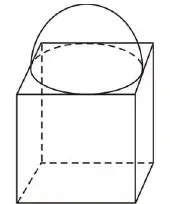
(a) A cubical block of side 7 cm is surmounted by a hemisphere of largest possible diameter as shown in the figure. Find the total surface area of the solid.
Show solution
The hemisphere has radius r = cm.
Exposed area = cube surface area − covered circular base + hemisphere curved area
= 6 × 7² − πr² + 2πr² = 294 + πr²
= 294 + ()()² = 332.5 cm².
332.5 cm²
OR
Older-syllabus alternative · retained from the original OR pair
(b) How many solid cones of height 3 cm and radius 2 cm can be formed by melting a solid sphere of radius 3 cm?
Show solution
Let n be the number of cones. Volume is conserved.
n × ()π × 2² × 3 = ()π × 3³
4πn = 36π, so n = 9.
9 cones
The melting alternative is retained to preserve the original OR pair and is labelled older-syllabus practice.
Question 10
Older-syllabus alternative · retained from the original OR pair
(a) A cone of height 20 cm and base radius 5 cm is made of clay. A child reshapes it in the form of a sphere. Find the diameter of the sphere.
Show solution
The cone and sphere have equal volumes.
()π × 5² × 20 = ()πR³
R³ = 125, so R = 5 cm.
Diameter = 2R = 10 cm.
10 cm
OR
(b) Three cubes each of volume 64 cm³ are joined end to end to form a cuboid. Find the surface area of the resulting cuboid.
Show solution
Each cube has side ∛64 = 4 cm.
The cuboid has dimensions 12 cm × 4 cm × 4 cm.
Surface area = 2(12 × 4 + 4 × 4 + 4 × 12) = 224 cm².
224 cm²
The reshaping alternative is retained to preserve the original OR pair and is labelled older-syllabus practice.
Question 11
(a) Two cubes each of edge 12 cm are joined edge to edge. Find the surface area of the resulting cuboid.
Show solution
The resulting cuboid has length 24 cm, breadth 12 cm and height 12 cm.
Surface area = 2(lb + bh + hl)
= 2(24 × 12 + 12 × 12 + 12 × 24)
= 1440 cm².
1440 cm²
OR
(b) A solid is hemispherical at the bottom and conical of same radius, above it. If the surface areas of the two parts are equal, find the ratio of its radius and the height of its conical part.
Show solution
Let the common radius be r, cone height h and slant height l. The common circular face is internal.
Equating the exposed curved areas gives 2πr² = πrl, so l = 2r.
Using l² = h² + r² gives 4r² = h² + r², hence h = √3r.
Therefore r : h = 1 : √3.
1 : √3
The paper says “edge to edge” and specifies a resulting cuboid. The official scheme uses dimensions 24 × 12 × 12 cm.
Volumes and displacement
Question 2
A metallic hollow cylindrical pipe has outer and inner radii as 6 cm and 4 cm respectively. Find the volume of the metal used in the pipe of length 14 cm.
Show solution
Volume of metal = outer cylinder volume − inner cylinder volume
V = π(R² − r²)h
= ()(6² − 4²) × 14
= 880 cm³.
880 cm³
Question 4
(a) A solid is in the shape of a cone standing on a hemisphere with both their radii being equal to 1 cm and the height of the cone is equal to its radius. Find the volume of the solid in terms of π.
Show solution
Common radius r = 1 cm and cone height h = 1 cm.
Volume of solid = volume of cone + volume of hemisphere
= ()πr²h + ()πr³
= π/3 + 2π/3 = π cm³.
π cm³
OR
(b) Find the volume of a solid hemisphere whose total surface area is 462 sq. m.
Show solution
Total surface area = 3πr² = 462.
r² = 462 × 7/(3 × 22) = 49, so r = 7 m.
Volume = ()πr³
= ()() × 7³ = m³.
m³ ≈ 718.67 m³
Question 9
(a) 150 spherical marbles, each of diameter 1.4 cm, are dropped in a cylindrical vessel of diameter 7 cm containing some water, and are completely immersed in water. Find the rise in the level of water in the cylindrical vessel.
Show solution
Marble radius = 0.7 cm and vessel radius = 3.5 cm.
Volume displaced = total volume of the marbles.
π(3.5)²h = 150 × ()π(0.7)³
h = 150 × () × (0.7)³/(3.5)² = 5.6 cm.
5.6 cm
OR
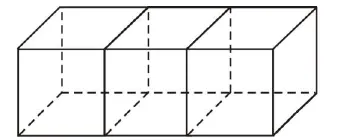
(b) Three cubes of side 6 cm each are joined as shown in the figure. Find the total surface area of the resulting cuboid.
Show solution
The cuboid has length 18 cm, breadth 6 cm and height 6 cm.
Surface area = 2(lb + bh + hl)
= 2(18 × 6 + 6 × 6 + 6 × 18) = 504 cm².
504 cm²
Dimensions, surface area and volume
Question 3
(a) Find the curved surface area of a right circular cone whose height is 15 cm and base radius is 8 cm. [Use π = ]
Show solution
Slant height l = √(15² + 8²) = √289 = 17 cm.
Curved surface area = πrl
= () × 8 × 17 = cm².
cm² ≈ 427.43 cm²
OR
(b) The surface area of a sphere is 616 sq cm. Find its radius. [Use π = ]
Show solution
4πr² = 616
r² = 616 × 7/(4 × 22) = 49
r = 7 cm.
7 cm
Question 5
A conical tent has the diameter of the base 24 m and slant height 13 m. Find its volume.
Show solution
Radius r = = 12 m.
Height h = √(l² − r²) = √(13² − 12²) = 5 m.
Volume = ()πr²h = ()π × 12² × 5
= 240π m³ = m³, using π = 22/7.
240π m³ = m³
Question 6
(a) The curved surface area of a right circular cylinder is 176 sq cm and its volume is 1232 cu cm. What is the height of the cylinder?
Show solution
2πrh = 176 and πr²h = 1232.
Dividing volume by curved surface area gives r/2 = = 7.
Therefore r = 14 cm.
h = 176/(2 × () × 14) = 2 cm.
2 cm
OR
(b) The largest sphere is carved out of a solid cube of side 21 cm. Find the volume of the sphere.
Show solution
The sphere’s diameter equals the cube’s side, so r = = 10.5 cm.
Volume = ()πr³
= ()()(10.5)³ = 4851 cm³.
4851 cm³
Question 7
The total surface area of a solid hemisphere is 462 sq. cm. Find its volume. [Take π = ]
Show solution
Total surface area = 3πr² = 462.
r² = 462 × 7/(3 × 22) = 49, so r = 7 cm.
Volume = ()πr³
= ()() × 7³ = cm³.
cm³ ≈ 718.67 cm³
Uses the same method as Q4(b). This standalone question uses cm² and cm³, while Q4(b) uses m² and m³.
Answer key · 18 worked answers
Official sources and question details
PDF page numbers count from the first physical page of each file.
Question 1
2022 · Basic · Term II · Main · 430/2/1 · Q3
Official Question paper · PDF pp. 3
Math_B/430-2-1 Maths Basic.pdf
Official Marking scheme · PDF pp. 3
Mathematics basic/Maths Basic paper code 430.2.1.pdf
2022 · Basic · Term II · Main · 430/2/2 · Q6
Official Question paper · PDF pp. 5
Math_B/430-2-2 Maths Basic.pdf
Official Marking scheme · PDF pp. 4
Mathematics basic/Maths Basic Paper code 430.2.2.pdf
Question 2
2022 · Basic · Term II · Main · 430/2/3 · Q3
Official Question paper · PDF pp. 5
Math_B/430-2-3 Maths Basic.pdf
Official Marking scheme · PDF pp. 3
Mathematics basic/Maths Basic Paper code 430.2.3.pdf
Question 3
2022 · Basic · Term II · Main · 430/4/1 · Q6
Official Question paper · PDF pp. 5
Math_B/430-4-1 Maths Basic.pdf
Official Marking scheme · PDF pp. 4
Mathematics basic/Maths Basic Paper code 430.4.1.pdf
2022 · Basic · Term II · Main · 430/4/3 · Q4
Official Question paper · PDF pp. 5
Math_B/430-4-3 Maths Basic.pdf
Official Marking scheme · PDF pp. 4
Mathematics basic/241_430_4_3_Mathematics (Basic).pdf
Question 4
2022 · Basic · Term II · Main · 430/4/2 · Q4
Official Question paper · PDF pp. 5
Math_B/430-4-2 Maths Basic.pdf
Official Marking scheme · PDF pp. 3
Mathematics basic/241_430_4_2_Mathematics (Basic).pdf
Question 5
2022 · Basic · Term II · Main · 430/B/5 · Q4
Official Question paper · PDF pp. 5
Math_B/430-B-5 Maths Basic for VI candidates.pdf
Official Marking scheme · PDF pp. 3
Mathematics basic/Maths Basic Paper code 430.B.5.pdf
Question 6
2022 · Standard · Term II · Main · 30/4/1 · Q6
Official Question paper · PDF pp. 5
Math_S/30-4-1 Maths Standard.pdf
Official Marking scheme · PDF pp. 5
Mathematic_Standard/041_30_4_1_Mathematics (Standard).pdf
2022 · Standard · Term II · Main · 30/4/2 · Q3
Official Question paper · PDF pp. 5
Math_S/30-4-2 Maths Standard.pdf
Official Marking scheme · PDF pp. 5
Mathematic_Standard/041_30_4_2_Mathematics (Standard).pdf
2022 · Standard · Term II · Main · 30/4/3 · Q3
Official Question paper · PDF pp. 3
Math_S/30-4-3 Maths Standard.pdf
Official Marking scheme · PDF pp. 5
Mathematic_Standard/041_30_4_3_Mathematics (Standard).pdf
Question 7
2022 · Basic · Term II · Supplementary · 430/B/6 · Q1
Official Question paper · PDF pp. 3
Maths_Basic/430-B-6 Maths Basic Blind.pdf
Official Marking scheme · PDF pp. 3
Math basic/430.B.6.pdf
Question 8
2022 · Basic · Term II · Main · 430/3/1 · Q4
Official Question paper · PDF pp. 3
Math_B/430-3-1 Maths Basic.pdf
Official Marking scheme · PDF pp. 3
Mathematics basic/Maths basic paper code430.3.1.pdf
2022 · Basic · Term II · Main · 430/3/2 · Q1
Official Question paper · PDF pp. 3
Math_B/430-3-2 Maths Basic.pdf
Official Marking scheme · PDF pp. 3
Mathematics basic/Maths Basic Paper code 430.3.2.pdf
2022 · Basic · Term II · Main · 430/3/3 · Q6
Official Question paper · PDF pp. 5
Math_B/430-3-3 Maths Basic.pdf
Official Marking scheme · PDF pp. 3
Mathematics basic/Maths Basic Paper Code 430.3.3.pdf
Question 9
2022 · Standard · Term II · Main · 30/3/1 · Q4
Official Question paper · PDF pp. 5
Math_S/30-3-1 Maths Standard.pdf
Official Marking scheme · PDF pp. 4
Mathematic_Standard/marking Scheme _041_30_3_1_.pdf
2022 · Standard · Term II · Main · 30/3/2 · Q3
Official Question paper · PDF pp. 3
Math_S/30-3-2 Maths Standard.pdf
Official Marking scheme · PDF pp. 4
Mathematic_Standard/Marking Scheme 041_30_3_2.pdf
2022 · Standard · Term II · Main · 30/3/3 · Q6
Official Question paper · PDF pp. 5
Math_S/30-3-3 Maths Standard.pdf
Official Marking scheme · PDF pp. 5
Mathematic_Standard/Marking Scheme 041_30_3_3.pdf
Question 10
2022 · Standard · Term II · Supplementary · 30/B/6 · Q4
Official Question paper · PDF pp. 5
Maths_Std/30-B-6 Maths Std. for VI candidates.pdf
Official Marking scheme · PDF pp. 4, 5
Math standered/30-B-6.pdf
Question 11
2026 · Standard · Second Board · 30(B) · Q25
Official Question paper · PDF pp. 15
Mathmatics_Std/30-B_Maths Std_E2_10_2026.pdf
Official Marking scheme · PDF pp. 10
Mathematics_Standard/MS_X_041_Mathematics_30B_II_Board_2025-26.pdf
CBSE Mathematics syllabus 2026–27 · NCERT Class 10, Chapter 12
Coverage · Left out and why
The screening covered the available 2022–2026 board-paper archives and ten official Basic/Standard sample papers for sessions 2022–23 to 2026–27. Scanned two-mark section pages were rendered and read with OCR, then included question pages were visually checked.
No eligible standalone Surface Areas and Volumes two-mark item was identified in the screened 2023–2025 papers or the ten official sample papers. Three front-page-only 2023 files cannot supply questions.
Two-mark subparts also occur within four-mark case studies. For example, Q38(iii) of the 2024–25 Mathematics Basic official sample paper has a two-mark OR choice about the surface area of a pencil or the volume of its shortened cylindrical part. These remain with the complete question on the Surface Areas and Volumes case-study page, following the preceding chapter’s resource structure.
Standalone 2022 melting/recasting questions were left out of current-syllabus practice. Two such alternatives remain visibly labelled because their original OR partners are relevant geometry questions. Single-solid questions support the formulas needed for combinations. Joined-cube and displacement questions are included as chapter practice.
Repeated full groups are merged. A repeated alternative can remain inside a different original OR pair. Counts describe question groups and worked answers.
Frequently asked questions
Why do we subtract a common face when solids are joined?
The shared face lies inside the combined solid. Count only the exposed surfaces when finding its surface area.
Does the total surface area of a hemisphere include its circular base?
Yes. Total surface area is 3πr², while curved surface area is 2πr². Use the wording of the question to choose the formula.
Why are two alternatives marked older-syllabus practice?
Those melting or reshaping alternatives appear in original 2022 OR pairs. They are retained with their paired surface-area questions so the original exam choice remains intact. The current syllabus specifies surface areas and volumes of combinations of listed solids.
How do I find the slant height of a cone?
For a right circular cone, use l² = r² + h², where l is the slant height, r is the base radius and h is the perpendicular height. Find l before using the curved-surface-area formula πrl.
What is the surface area when two equal cubes are joined face to face?
If each cube has side a and they share one full square face, the resulting cuboid measures 2a × a × a. Its surface area is 2(2a² + a² + 2a²) = 10a².
Which units should I use for surface area and volume?
Express all lengths in the same unit before substituting. Surface area uses square units such as cm² or m². Volume uses cubic units such as cm³ or m³. For capacity, 1 cm³ = 1 mL and 1000 cm³ = 1 L.
Make combined solids clearer
Get 1-to-1 help reading diagrams, choosing formulas and writing concise exam solutions.
Book a Free Assessment