2026/27 Enrolment Open · Free Assessment

Chapter 6 · Written-answer practice

Triangles 2-Mark Questions Class 10: CBSE PYQs with Answers

Practise 52 selected Triangles questions worth 2 marks each, from CBSE Class 10 Basic and Standard board papers, and official sample papers. Practise BPT, AA and SAS similarity, corresponding-side ratios, and shadow problems. Try each question before opening its solution.

52 numbered questions · 74 board-paper appearances + 7 sample pairings
71 worked solutions, including both alternatives in 19 OR pairs
By , Lead Maths Tutor, TutorVertex · Solutions prepared with Team TutorVertex
Updated

Key results for Triangles 2-mark questions

UseResult
BPTIf DE ∥ BC in △ABC, then AD/DB = AE/EC.
Converse of BPTIf AD/DB = AE/EC, then DE ∥ BC.
AA similarityTwo pairs of equal corresponding angles establish similarity.
SAS similarityTwo pairs of corresponding sides are proportional and their included angles are equal.
Corresponding sidesIf △ABC ∼ △PQR, then AB/PQ = BC/QR = AC/PR.
Perimeter ratioFor similar triangles, the perimeter ratio equals the corresponding-side ratio.
Which theorem should I use?
GivenStarting point
A parallel line in a triangleUse BPT for divided sides or AA similarity for whole-side ratios.
Equal division ratiosUse the converse of BPT to prove the line parallel.
Two equal angle pairsWrite the triangles in matching order and use AA.
Two proportional side pairsCheck their included angles before using SAS.
A length or a shadowEstablish similarity, then write one proportion with matching sides.

Showing all 52 questions

Questions on this page — Show list

Basic proportionality theorem and its converse

  1. Question 1 · Basic
  2. Question 2 · Basic
  3. Question 3 · Basic
  4. Question 4 · Standard
  5. Question 5 · Basic
  6. Question 6 · Basic
  7. Question 7 · Standard
  8. Question 8 · Basic
  9. Question 9 · Standard
  10. Question 10 · Standard
  11. Question 11 · Basic
  12. Question 12 · Standard
  13. Question 13 · Basic

Similarity proofs and corresponding sides

  1. Question 14 · Basic and Standard
  2. Question 15 · Standard
  3. Question 16 · Standard
  4. Question 17 · Basic
  5. Question 18 · Basic
  6. Question 19 · Basic
  7. Question 20 · Basic
  8. Question 21 · Standard
  9. Question 22 · Standard
  10. Question 23 · Standard
  11. Question 24 · Standard
  12. Question 25 · Basic
  13. Question 26 · Standard
  14. Question 27 · Standard
  15. Question 28 · Standard
  16. Question 29 · Basic
  17. Question 30 · Standard
  18. Question 31 · Standard
  19. Question 32 · Standard
  20. Question 33 · Standard
  21. Question 34 · Standard

Finding lengths, angles and perimeter ratios

  1. Question 35 · Standard
  2. Question 36 · Basic
  3. Question 37 · Basic
  4. Question 38 · Standard
  5. Question 39 · Standard
  6. Question 40 · Standard
  7. Question 41 · Basic
  8. Question 42 · Basic
  9. Question 43 · Basic
  10. Question 44 · Standard
  11. Question 45 · Basic
  12. Question 46 · Basic
  13. Question 47 · Basic
  14. Question 48 · Standard
  15. Question 49 · Standard
  16. Question 50 · Standard

Shadows and similar-triangle applications

  1. Question 51 · Basic
  2. Question 52 · Standard

Basic proportionality theorem and its converse

Basic2 marks

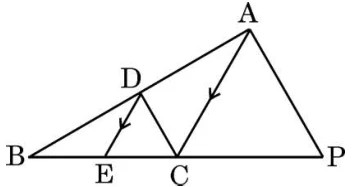
Q1. In the given figure, DE ∥ AC and BEEC = BCCP. Prove that DC ∥ AP. [2 marks]

B, E, C and P are collinear, in that order. D lies on BA. DE is parallel to AC.
CBSE question diagram.

Appeared in: 2023 · Basic · Main

Show answer and solution

In △BAC, DE ∥ AC, so BD/DA = BE/EC by BPT.

Given BE/EC = BC/CP, hence BD/DA = BC/CP.

In △BAP, D lies on BA and C lies on BP.

By the converse of BPT, DC ∥ AP.

DC ∥ AP
Basic2 marks

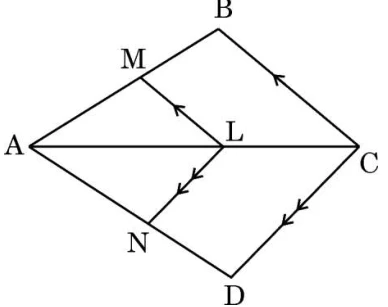
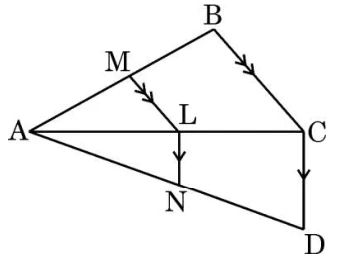
Q2. In the given figure, LM ∥ CB and LN ∥ CD. Prove that AMAN = ABAD. [2 marks]

M lies on AB, L on AC and N on AD. ML is parallel to BC and LN is parallel to CD.
CBSE question diagram.

Appeared in: 2023 · Basic · Main

Show answer and solution

In △ABC, ML ∥ BC, so AM/AB = AL/AC by similarity.

In △ACD, LN ∥ CD, so AN/AD = AL/AC.

Therefore AM/AB = AN/AD.

Rearranging gives AM/AN = AB/AD.

AM/AN = AB/AD

Basic2 marks

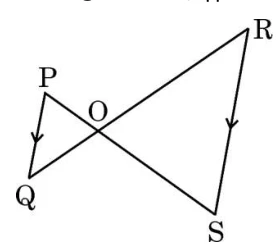
Q3. (a) In the given figure, PQ ∥ RS. Prove that OP × OR = OQ × OS. [2 marks]

P, O, S and Q, O, R lie on two intersecting lines; PQ is parallel to RS.
CBSE question diagram.
Show answer and solution

∠OPQ = ∠OSR (alternate interior angles).

∠POQ = ∠SOR (vertically opposite angles).

Therefore △OPQ ∼ △OSR by AA.

OP/OS = OQ/OR.

OP × OR = OQ × OS.

OP × OR = OQ × OS

OR

(b) In the given figure, LM ∥ CB and LN ∥ CD. Prove that AMAN = ABAD. [2 marks]

M lies on AB, L on AC and N on AD, with ML parallel to BC and LN parallel to CD.
CBSE question diagram.

Appeared in: 2024 · Basic · Main

Show answer and solution

In △ABC, ML ∥ BC, so AM/AB = AL/AC.

In △ACD, LN ∥ CD, so AN/AD = AL/AC.

Equating the two ratios gives AM/AB = AN/AD.

Rearranging gives AM/AN = AB/AD.

AM/AN = AB/AD

Standard2 marks · Includes accessible-paper appearance

Q4. E and F are points on sides PQ and PR respectively of △PQR. If PE = 3.9 cm, EQ = 3 cm, PF = 3.6 cm and PR = 6 cm, find whether EF ∥ QR. [2 marks]

Appeared in: 2024 · Standard · Supplementary

Show answer and solution

FR = PR − PF = 6 − 3.6 = 2.4 cm.

PE/EQ = 3.9/3 = 1.3.

PF/FR = 3.6/2.4 = 1.5.

The ratios are unequal, so the sides are not divided proportionally.

Therefore EF is not parallel to QR.

EF is not parallel to QR

Basic2 marks

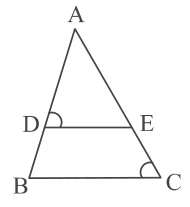
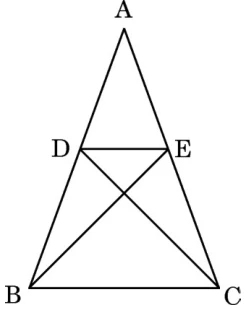
Q5. In the given figure, ∠ADE = ∠ACB and ADDB = AEEC. Prove that △ABC is an isosceles triangle. [2 marks]

D lies on AB and E on AC. Angles ADE and ACB are marked equal.
CBSE question diagram.

Appeared in: 2025 · Basic · Main

Show answer and solution

AD/DB = AE/EC, so DE ∥ BC by the converse of BPT.

Thus ∠ADE = ∠ABC (corresponding angles).

Given ∠ADE = ∠ACB, therefore ∠ABC = ∠ACB.

Sides opposite equal angles are equal, so AB = AC.

AB = AC; △ABC is isosceles

Basic2 marks

Q6. In the given figure, AB ∥ DE and BD ∥ EF. Prove that DC² = CF × AC. [2 marks]

D and F lie on CA, E lies on CB, DE is parallel to AB and EF is parallel to BD.
CBSE question diagram.

Appeared in: 2025 · Basic · Main

Show answer and solution

In △CAB, DE ∥ AB, so CD/CA = CE/CB.

In △CBD, EF ∥ BD, so CF/CD = CE/CB.

Therefore CD/CA = CF/CD.

Cross-multiplying gives DC² = CF × AC.

DC² = CF × AC

Standard2 marks

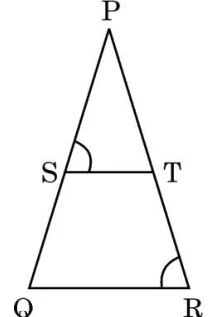
Q7. (a) In the given figure, PSSQ = PTTR and ∠PST = ∠PRQ. Prove that △PQR is isosceles. [2 marks]

S lies on PQ and T on PR, with angles PST and PRQ marked equal.
CBSE question diagram.
Show answer and solution

PS/SQ = PT/TR, so ST ∥ QR by the converse of BPT.

Hence ∠PST = ∠PQR (corresponding angles).

Given ∠PST = ∠PRQ, so ∠PQR = ∠PRQ.

Therefore PQ = PR.

PQ = PR; △PQR is isosceles

OR

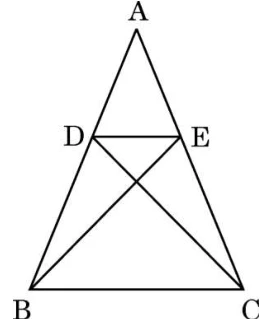
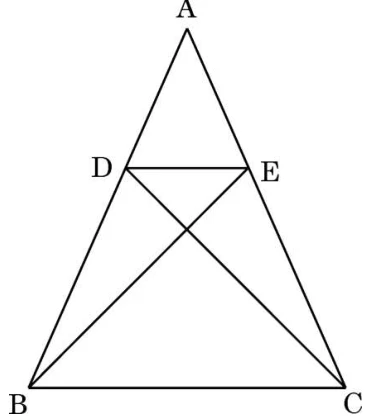
(b) In the given figure, △ABE ≅ △ACD. Show that △ADE ∼ △ABC. [2 marks]

D lies on AB and E on AC. BE and CD are drawn.
CBSE question diagram.

Appeared in: 2025 · Standard · Main

Show answer and solution

Since △ABE ≅ △ACD, AB = AC and AE = AD (CPCT).

Thus AD/AB = AE/AC.

∠DAE = ∠BAC, as D lies on AB and E lies on AC.

Therefore △ADE ∼ △ABC by SAS similarity.

△ADE ∼ △ABC

Basic2 marks · Includes accessible-paper appearance

Q8. (a) P and Q are points on sides DE and DF respectively of △DEF such that DP = 5 cm, DQ = 6 cm, DE = 15 cm and QF = 18 cm. Find whether PQ ∥ EF or not. [2 marks]

Show answer and solution

PE = DE − DP = 15 − 5 = 10 cm.

DP/PE = 5/10 = 1/2.

DQ/QF = 6/18 = 1/3.

The ratios are unequal, so PQ is not parallel to EF.

PQ is not parallel to EF

OR

(b) Prove that the line joining the mid-points of any two sides of a triangle is parallel to the third side. [2 marks]

Appeared in: 2025 · Basic · Supplementary

Show answer and solution

Let D and E be midpoints of AB and AC in △ABC.

AD = DB and AE = EC.

Thus AD/DB = AE/EC = 1.

By the converse of BPT, DE ∥ BC.

The line joining the midpoints is parallel to the third side

Standard2 marks · Includes accessible-paper appearance

Q9. (a) S and T are points on sides PR and QR of △PQR such that ∠P = ∠RTS. Show that △RPQ ∼ △RTS. [2 marks]

Show answer and solution

∠RPQ = ∠RTS (given).

∠PRQ = ∠TRS, since R, S, P and R, T, Q are collinear.

Therefore △RPQ ∼ △RTS by AA.

△RPQ ∼ △RTS

OR

(b) If a line intersects sides AB and AC of △ABC at D and E respectively and is parallel to BC, prove that ADAB = AEAC. [2 marks]

Appeared in: 2025 · Standard · Supplementary

Show answer and solution

By BPT, AD/DB = AE/EC, so DB/AD = EC/AE.

Adding 1 gives (AD + DB)/AD = (AE + EC)/AE.

Hence AB/AD = AC/AE.

Taking reciprocals gives AD/AB = AE/AC.

AD/AB = AE/AC

Standard2 marks

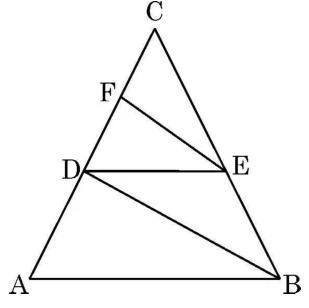
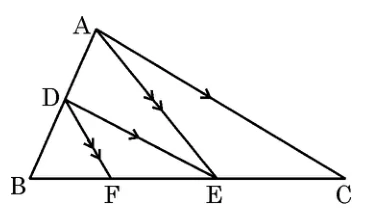
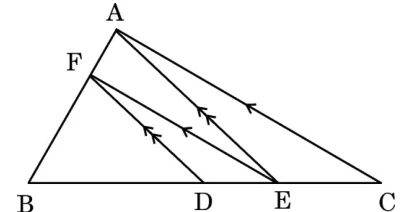
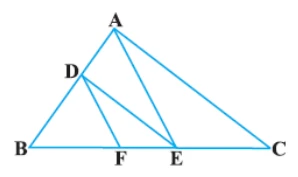
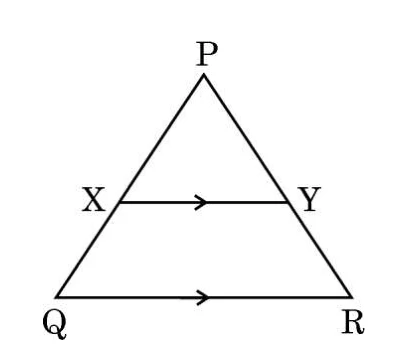
Q10. In the given figure, DE ∥ AC and DF ∥ AE. Prove that BFFE = BEEC. [2 marks]

D lies on BA; F and E lie on BC. DE is parallel to AC and DF is parallel to AE.
CBSE question diagram.

Appeared in: 2026 · Standard · Main

Show answer and solution

In △BAE, DF ∥ AE, so BF/FE = BD/DA by BPT.

In △BAC, DE ∥ AC, so BE/EC = BD/DA by BPT.

Equating gives BF/FE = BE/EC.

BF/FE = BE/EC

Basic2 marks

Q11. (a) In the given figure, EF ∥ CA and DF ∥ EA. Prove that BDDE = BEEC. [2 marks]

F lies on BA; D and E lie on BC. EF is parallel to CA and DF is parallel to EA.
CBSE question diagram.
Show answer and solution

In △BEA, DF ∥ EA, so BD/DE = BF/FA by BPT.

In △BCA, EF ∥ CA, so BE/EC = BF/FA by BPT.

Thus BD/DE = BE/EC.

BD/DE = BE/EC

OR

(b) In the given figure, △ABE ≅ △ACD. Show that △ADE ∼ △ABC. [2 marks]

D lies on AB and E on AC, with BE and CD drawn.
CBSE question diagram.

Appeared in: 2026 · Basic · Second board examination

Show answer and solution

Since △ABE ≅ △ACD, AB = AC and AE = AD (CPCT).

Thus AD/AB = AE/AC.

∠DAE = ∠BAC, as D lies on AB and E lies on AC.

Therefore △ADE ∼ △ABC by SAS similarity.

△ADE ∼ △ABC

Standard2 marks

Q12. (a) X and Y are points on sides PQ and PR respectively of △PQR. If PX, QX, PY and YR are 4, 4.5, 8 and 9 cm respectively, show that XY ∥ QR. [2 marks]

Show answer and solution

PX/XQ = 4/4.5 = 8/9.

PY/YR = 8/9.

Thus PX/XQ = PY/YR.

By the converse of BPT, XY ∥ QR.

XY ∥ QR

OR

(b) ABCD is a trapezium in which AB ∥ CD and P and Q are points on AD and BC respectively such that PQ ∥ DC. If PD = 18 cm, BQ = 3.5 cm and QC = 15 cm, find AD. [2 marks]

Appeared in: 2026 · Standard · Second board examination

Show answer and solution

Join BD and let it meet PQ at R.

In △DAB, PR ∥ AB, so AP/PD = BR/RD by BPT.

In △BCD, RQ ∥ CD, so BQ/QC = BR/RD by BPT.

Thus AP/18 = 3.5/15, giving AP = 4.2 cm.

AD = AP + PD = 4.2 + 18 = 22.2 cm.

AD = 22.2 cm

Basic2 marks

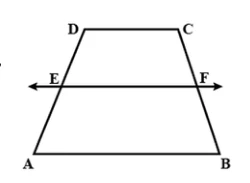
Q13. (a) In the given figure, ABCD is a trapezium in which AB ∥ CD ∥ EF. Prove that AEED = BFFC. [2 marks]

ABCD is a trapezium with EF parallel to AB and CD.
CBSE question diagram.
Show answer and solution

Draw AC and let it meet EF at G.

In △ADC, EG ∥ DC, so AE/ED = AG/GC by BPT.

In △ABC, GF ∥ AB, so CG/GA = CF/FB.

Taking reciprocals gives AG/GC = BF/FC.

Therefore AE/ED = BF/FC.

AE/ED = BF/FC

OR

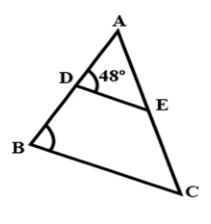
(b) In the given figure, AD = 6 cm, DB = 9 cm, AE = 8 cm, EC = 12 cm and ∠ADE = 48°. Find ∠ABC. [2 marks]

D lies on AB and E on AC, with AD 6, DB 9, AE 8, EC 12 and angle ADE 48 degrees.
CBSE question diagram.

Appeared in: 2023–24 · Basic · Official sample

Show answer and solution

AD/DB = 6/9 = 2/3 and AE/EC = 8/12 = 2/3.

By the converse of BPT, DE ∥ BC.

Therefore ∠ABC = ∠ADE = 48° (corresponding angles).

∠ABC = 48°

Similarity proofs and corresponding sides

Basic and Standard2 marks

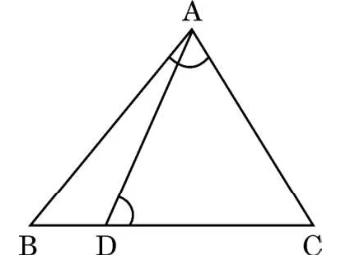
Q14. D is a point on the side BC of △ABC such that ∠ADC = ∠BAC. Show that AC² = BC × DC. [2 marks]

D lies on BC, with angle ADC equal to angle BAC.
CBSE question diagram.

Appeared in: 2025 · Basic · Main; 2026 · Standard · Main

Show answer and solution

In △ADC and △BAC, ∠ADC = ∠BAC (given).

∠ACD = ∠BCA, since B, D and C are collinear.

Therefore △ADC ∼ △BAC by AA similarity.

AC/BC = DC/AC (corresponding sides).

AC² = BC × DC.

AC² = BC × DC

Standard2 marks

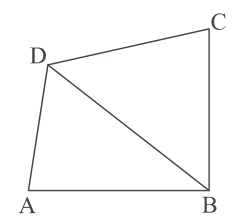
Q15. In the given figure, ABCD is a quadrilateral. Diagonal BD bisects ∠B and ∠D both. Prove that (i) △ABD ∼ △CBD and (ii) AB = BC. [2 marks]

ABCD has diagonal BD, which bisects both angle ABC and angle ADC.
CBSE question diagram.

Appeared in: 2024 · Standard · Main

Show answer and solution

∠ABD = ∠CBD and ∠ADB = ∠CDB, since BD bisects the two angles.

Therefore △ABD ∼ △CBD by AA.

AB/CB = BD/BD = 1 (corresponding sides).

Hence AB = BC.

△ABD ∼ △CBD; AB = BC

Standard2 marks · Includes accessible-paper appearance

Q16. (a) In △ABC, D and E are points on the sides AB and AC respectively such that BD = CE. If ∠B = ∠C, show that DE ∥ BC. [2 marks]

Show answer and solution

Since ∠B = ∠C, AB = AC (sides opposite equal angles).

AD = AB − BD and AE = AC − CE.

Thus AD = AE, and AD/DB = AE/EC.

By the converse of BPT, DE ∥ BC.

DE ∥ BC

OR

(b) If △ABC ∼ △DEF and AB = 4 cm, DE = 6 cm, EF = 9 cm and FD = 12 cm, find the perimeter of △ABC. [2 marks]

Appeared in: 2024 · Standard · Main

Show answer and solution

The ratio of corresponding sides is AB/DE = 4/6 = 2/3.

BC = (2/3) × 9 = 6 cm.

CA = (2/3) × 12 = 8 cm.

Perimeter = 4 + 6 + 8 = 18 cm.

Perimeter of △ABC = 18 cm

Basic2 marks

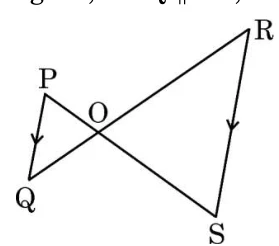
Q17. (a) In the given figure, if PQ ∥ RS, prove that △POQ ∼ △SOR. [2 marks]

PQ and RS are parallel, and PS and QR intersect at O.
CBSE question diagram.
Show answer and solution

∠OPQ = ∠OSR (alternate interior angles, PQ ∥ RS).

∠POQ = ∠SOR (vertically opposite angles).

Therefore △POQ ∼ △SOR by AA similarity.

△POQ ∼ △SOR

OR

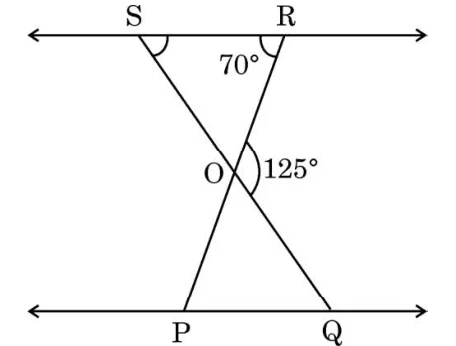
(b) In the given figure, △OSR ∼ △OQP, ∠ROQ = 125° and ∠ORS = 70°. Find the measures of ∠OSR and ∠OQP. [2 marks]

RS and PQ are parallel. ROQ is 125 degrees and ORS is 70 degrees.
CBSE question diagram.

Appeared in: 2025 · Basic · Main

Show answer and solution

∠SOR = 180° − ∠ROQ = 55° (linear pair).

In △OSR, ∠OSR = 180° − 55° − 70° = 55°.

Since △OSR ∼ △OQP, ∠OQP = ∠OSR = 55°.

∠OSR = 55°; ∠OQP = 55°

Basic2 marks

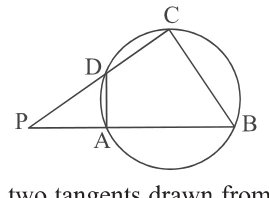
Q18. Two chords BA and CD intersect at a point P outside the circle. Prove that △PDA ∼ △PBC. [2 marks]

P is outside the circle; P, A, B and P, D, C are collinear. AD and BC are chords.
CBSE question diagram.

Appeared in: 2025 · Basic · Main

This proof also uses the cyclic-quadrilateral angle property from earlier geometry.

Show answer and solution

∠DAB + ∠DCB = 180° (opposite angles of cyclic quadrilateral).

∠PAD + ∠DAB = 180° (linear pair), so ∠PAD = ∠PCB.

∠DPA = ∠BPC, since P, A, B and P, D, C are collinear.

Therefore △PDA ∼ △PBC by AA.

△PDA ∼ △PBC

Basic2 marks

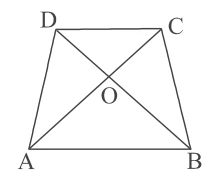
Q19. In a trapezium ABCD, AB ∥ DC and its diagonals intersect at O. Prove that OAOC = OBOD. [2 marks]

Appeared in: 2025 · Basic · Main

Show answer and solution

Since AB ∥ CD, ∠ABO = ∠CDO and ∠BAO = ∠DCO (alternate interior angles).

Therefore △AOB ∼ △COD by AA.

Corresponding sides give OA/OC = OB/OD.

OA/OC = OB/OD

Basic2 marks · Includes accessible-paper appearance

Q20. (a) Prove that diagonals of a trapezium divide each other proportionally. [2 marks]

Show answer and solution

Let diagonals AC and BD of trapezium ABCD meet at O, with AB ∥ CD.

Since AB ∥ CD, ∠ABO = ∠CDO and ∠BAO = ∠DCO (alternate interior angles).

Therefore △AOB ∼ △COD by AA.

Corresponding sides give OA/OC = OB/OD.

OA/OC = OB/OD

OR

(b) S is a point on the side QR of △PQR such that ∠PSR = ∠QPR. Prove that PR² = QR × SR. [2 marks]

Appeared in: 2025 · Basic · Main

Show answer and solution

In △PSR and △QPR, ∠PSR = ∠QPR (given).

∠PRS = ∠QRP, since Q, S and R are collinear.

Therefore △PSR ∼ △QPR by AA.

PR/QR = SR/PR.

Hence PR² = QR × SR.

PR² = QR × SR

Standard2 marks

Q21. (a) In the given figure, D is a point on side BC of △ABC such that ∠ADC = ∠BAC. Show that CA² = CD × CB. [2 marks]

D lies on BC, with angle ADC equal to angle BAC.
CBSE question diagram.
Show answer and solution

In △ADC and △BAC, ∠ADC = ∠BAC (given).

∠ACD = ∠BCA, since B, D and C are collinear.

Therefore △ADC ∼ △BAC by AA similarity.

AC/BC = DC/AC (corresponding sides).

AC² = BC × DC.

CA² = CD × CB

OR

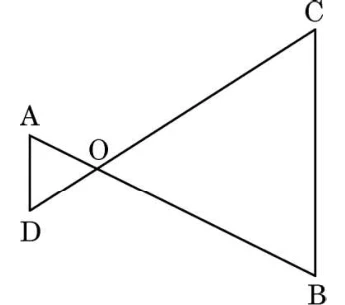
(b) In the given figure, OA × OB = OC × OD. Show that ∠A = ∠C and ∠B = ∠D. [2 marks]

A, O, B and D, O, C are collinear, forming triangles AOD and COB.
CBSE question diagram.

Appeared in: 2025 · Standard · Main

Show answer and solution

Given OA × OB = OC × OD, so OA/OC = OD/OB.

∠AOD = ∠COB (vertically opposite angles).

Therefore △AOD ∼ △COB by SAS similarity.

Corresponding angles give ∠A = ∠C and ∠D = ∠B.

∠A = ∠C; ∠B = ∠D

Standard2 marks

Q22. AD and PS are medians of triangles ABC and PQR respectively such that △ABD ∼ △PQS. Prove that △ABC ∼ △PQR. [2 marks]

Appeared in: 2025 · Standard · Main

Show answer and solution

Since AD and PS are medians, BC = 2BD and QR = 2QS.

Given △ABD ∼ △PQS, so AB/PQ = BD/QS and ∠ABD = ∠PQS.

Thus AB/PQ = BC/QR and ∠ABC = ∠PQR.

Therefore △ABC ∼ △PQR by SAS similarity.

△ABC ∼ △PQR

Standard2 marks

Q23. AD and PS are angle bisectors of ∠A and ∠P of triangles ABC and PQR. If △ABC ∼ △PQR, prove that △ACD ∼ △PRS. [2 marks]

Appeared in: 2025 · Standard · Main

Show answer and solution

Since △ABC ∼ △PQR, ∠A = ∠P and ∠C = ∠R.

AD and PS bisect ∠A and ∠P, so ∠CAD = ∠RPS.

Also ∠ACD = ∠PRS, since D lies on BC and S lies on QR.

Therefore △ACD ∼ △PRS by AA.

△ACD ∼ △PRS

Standard2 marks

Q24. In △ABC and △PQR, AD and PS are altitudes such that △ABD ∼ △PQS and △ACD ∼ △PRS. Prove that △ABC ∼ △PQR. [2 marks]

Appeared in: 2025 · Standard · Main

Show answer and solution

From △ABD ∼ △PQS, ∠ABD = ∠PQS.

From △ACD ∼ △PRS, ∠ACD = ∠PRS.

As D and S are the feet on BC and QR, ∠ABC = ∠PQR and ∠ACB = ∠PRQ.

Therefore △ABC ∼ △PQR by AA.

△ABC ∼ △PQR

Basic2 marks

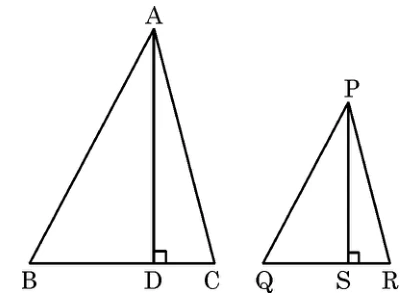
Q25. In the given figure, two triangles ABC and PQR are such that ∠A = ∠P and ∠C = ∠R. If AD ⊥ BC and PS ⊥ QR, prove that (i) △ADB ∼ △PSQ and (ii) AD × QS = BD × PS. [2 marks]

AD and PS are perpendiculars from the vertices A and P to BC and QR.
CBSE question diagram.

Appeared in: 2026 · Basic · Main

Show answer and solution

In △ABC and △PQR, ∠B = ∠Q by the angle sum property.

∠ADB = ∠PSQ = 90° and ∠ABD = ∠PQS.

Therefore △ADB ∼ △PSQ by AA.

AD/PS = BD/QS (corresponding sides).

Cross-multiplying gives AD × QS = BD × PS.

△ADB ∼ △PSQ; AD × QS = BD × PS

Standard2 marks

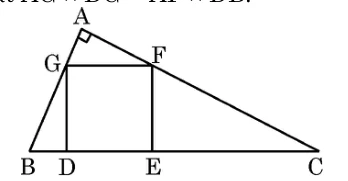
Q26. In the given figure, DEFG is a square. ABC is a right triangle with ∠A = 90°. Prove that AG × DG = AF × DB. [2 marks]

DEFG is a square with D and E on BC, G on AB and F on AC. Angle A is a right angle.
CBSE question diagram.

Appeared in: 2026 · Standard · Main

Show answer and solution

∠GAF = ∠BDG = 90°, since ∠A = 90° and DEFG is a square.

∠AGF = ∠DBG, since A, G, B are collinear and GF ∥ BD.

Therefore △AGF ∼ △DBG by AA similarity.

AG/DB = AF/DG (corresponding sides).

Hence AG × DG = AF × DB.

AG × DG = AF × DB

Standard2 marks

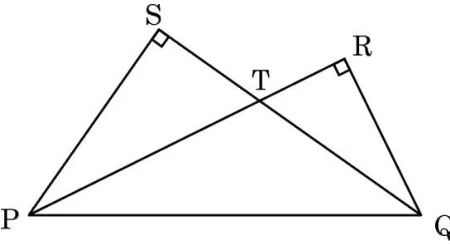
Q27. Two right triangles PRQ and PSQ are drawn on the same hypotenuse PQ. If PR and QS intersect at T, prove that ST × TQ = PT × TR. [2 marks]

PRQ and PSQ are right triangles with common hypotenuse PQ. PR and SQ intersect at T.
CBSE question diagram.

Appeared in: 2026 · Standard · Main

Show answer and solution

∠PST = ∠QRT = 90°.

∠PTS = ∠QTR (vertically opposite angles).

Therefore △PST ∼ △QRT by AA.

ST/TR = PT/TQ.

Hence ST × TQ = PT × TR.

ST × TQ = PT × TR

Standard2 marks

Q28. In the given figure, △ABE ≅ △ACD. Show that △ADE ∼ △ABC. [2 marks]

D lies on AB and E on AC, with BE, CD and DE drawn.
CBSE question diagram.

Appeared in: 2026 · Standard · Main

Show answer and solution

Since △ABE ≅ △ACD, AB = AC and AE = AD (CPCT).

Thus AD/AB = AE/AC.

∠DAE = ∠BAC, as D lies on AB and E lies on AC.

Therefore △ADE ∼ △ABC by SAS similarity.

△ADE ∼ △ABC

Basic2 marks

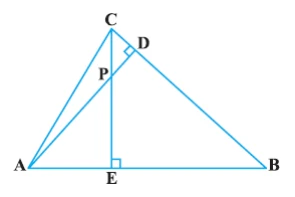
Q29. (a) In the figure, altitudes AD and CE of △ABC intersect at P. Prove that (i) △ABD ∼ △CBE and (ii) △PDC ∼ △BEC. [2 marks]

AD and CE are altitudes of ABC and meet at P.
CBSE question diagram.
Show answer and solution

∠ADB = ∠CEB = 90° and ∠ABD = ∠CBE, so △ABD ∼ △CBE by AA.

Also ∠PDC = ∠BEC = 90°.

∠PCD = ∠BCE, since C, P, E and C, D, B are collinear.

Therefore △PDC ∼ △BEC by AA.

△ABD ∼ △CBE; △PDC ∼ △BEC

OR

(b) In the given figure, DE ∥ AC and DF ∥ AE. Prove that BFFE = BEEC. [2 marks]

D lies on BA and F, E lie on BC; DE is parallel to AC and DF is parallel to AE.
CBSE question diagram.

Appeared in: 2022–23 · Basic · Official sample

Show answer and solution

In △BAE, DF ∥ AE, so BF/FE = BD/DA by BPT.

In △BAC, DE ∥ AC, so BE/EC = BD/DA by BPT.

Equating gives BF/FE = BE/EC.

BF/FE = BE/EC

Standard2 marks

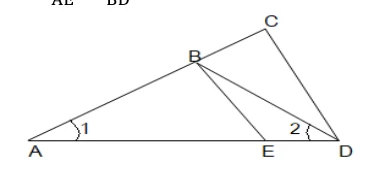
Q30. In the given figure, ADAE = ACBD and ∠1 = ∠2. Show that △BAE ∼ △CAD. [2 marks]

B lies on AC and E on AD; BD and BE are drawn. Angles BAD and BDA are equal.
CBSE question diagram.

Appeared in: 2022–23 · Standard · Official sample

Show answer and solution

In △ABD, ∠BAD = ∠ADB (given ∠1 = ∠2), so BD = AB.

Given AD/AE = AC/BD, hence AB/AC = AE/AD.

∠BAE = ∠CAD, since A, B, C are collinear and A, E, D are collinear.

Therefore △BAE ∼ △CAD by SAS similarity.

△BAE ∼ △CAD

Standard2 marks

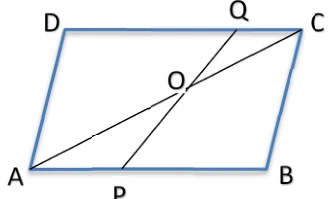
Q31. ABCD is a parallelogram. Point P divides AB in the ratio 2 : 3 and point Q divides DC in the ratio 4 : 1. Prove that OC is half of OA. [2 marks]

P lies on AB, Q on DC, and AC and PQ intersect at O in parallelogram ABCD.
CBSE question diagram.

Appeared in: 2023–24 · Standard · Official sample

Show answer and solution

AB = DC (opposite sides of a parallelogram).

AP = 2AB/5 and CQ = DC/5, so AP/CQ = 2.

AP ∥ CQ, so ∠APO = ∠CQO and ∠PAO = ∠QCO.

Therefore △APO ∼ △CQO by AA.

AO/CO = AP/CQ = 2.

OC = OA/2

Standard2 marks

Q32. If AP and DQ are medians of triangles ABC and DEF, where △ABC ∼ △DEF, prove that ABDE = APDQ. [2 marks]

Appeared in: 2025–26 · Standard · Official sample

Show answer and solution

From △ABC ∼ △DEF, AB/DE = BC/EF and ∠ABC = ∠DEF.

Since AP and DQ are medians, BP = BC/2 and EQ = EF/2.

Therefore AB/DE = BP/EQ and ∠ABP = ∠DEQ.

Thus △ABP ∼ △DEQ by SAS.

Hence AB/DE = AP/DQ.

AB/DE = AP/DQ

Standard2 marks

Q33. (a) ABCD is a trapezium in which AB is parallel to DC and its diagonals intersect at O. Show that AOBO = CODO. [2 marks]

Show answer and solution

Since AB ∥ CD, ∠ABO = ∠CDO and ∠BAO = ∠DCO (alternate interior angles).

Therefore △AOB ∼ △COD by AA.

Corresponding sides give OA/OC = OB/OD.

Rearranging OA/OC = OB/OD gives AO/BO = CO/DO.

AO/BO = CO/DO

OR

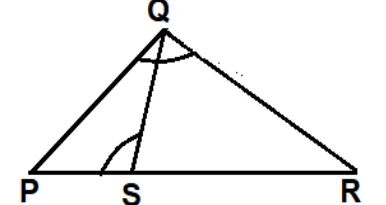
(b) In the given figure, if ∠PQR = ∠QSP, PQ = 6 cm and PS = 3 cm, find PR. [2 marks]

S lies on PR, Q is above PR, and QSP is equal to PQR.
CBSE question diagram.

Appeared in: 2026–27 · Standard · Official sample

Show answer and solution

∠PQR = ∠QSP (given) and ∠QPR = ∠SPQ (common angle).

Therefore △PQR ∼ △PSQ by AA.

PQ/PS = PR/PQ.

6/3 = PR/6.

PR = 12 cm.

PR = 12 cm

Standard2 marks

Q34. (a) ABCD is a trapezium in which AB is parallel to DC and its diagonals intersect at O. Show that AOBO = CODO. [2 marks]

Show answer and solution

Since AB ∥ CD, ∠ABO = ∠CDO and ∠BAO = ∠DCO (alternate interior angles).

Therefore △AOB ∼ △COD by AA.

Corresponding sides give OA/OC = OB/OD.

Rearranging OA/OC = OB/OD gives AO/BO = CO/DO.

AO/BO = CO/DO

OR

(b) In a right-angled triangle ABC, right-angled at B, a perpendicular BD is drawn to hypotenuse AC. Prove that △BCD ∼ △ACB. [2 marks]

Appeared in: 2026–27 · Standard · Official sample

Accessible alternative to the preceding sample question. Part (a) is shared; the full OR pairing is retained.

Show answer and solution

∠BDC = ∠ABC = 90°.

∠BCD = ∠ACB, since A, D and C are collinear.

Therefore △BCD ∼ △ACB by AA similarity.

△BCD ∼ △ACB

Finding lengths, angles and perimeter ratios

Standard2 marks · Includes accessible-paper appearance

Q35. P and Q are respectively the points on the sides AB and AC of a triangle ABC such that AB = 12.5 cm, AP = 5 cm and CQ = 6 cm. If PQ ∥ BC, find the length of AQ. [2 marks]

Appeared in: 2023 · Standard · Main

Show answer and solution

PB = AB − AP = 12.5 − 5 = 7.5 cm.

By BPT, AP/PB = AQ/QC.

5/7.5 = AQ/6.

AQ = 6 × 5/7.5 = 4 cm.

AQ = 4 cm

Basic2 marks

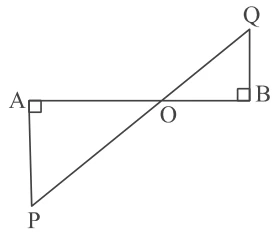
Q36. In the given figure, AP and BQ are perpendicular to AB. If OA = 15 cm, BO = 12 cm and AP = 10 cm, find BQ. [2 marks]

A, O and B lie on a horizontal line. AP and BQ are perpendicular to AB, and P, O, Q are collinear.
CBSE question diagram.

Appeared in: 2024 · Basic · Main

Show answer and solution

∠OAP = ∠OBQ = 90° and ∠AOP = ∠BOQ (vertically opposite).

Therefore △OAP ∼ △OBQ by AA.

AP/BQ = OA/OB.

10/BQ = 15/12.

BQ = 8 cm.

BQ = 8 cm

Basic2 marks · Includes accessible-paper appearance

Q37. A line l intersects sides PQ and PR of △PQR at L and M respectively such that LM ∥ QR. If PQ = 12 cm, PR = 10 cm and PL = 7.2 cm, find the length of PM. [2 marks]

Appeared in: 2024 · Basic · Main

Show answer and solution

Since LM ∥ QR, △PLM ∼ △PQR.

PL/PQ = PM/PR.

7.2/12 = PM/10.

PM = 6 cm.

PM = 6 cm

Standard2 marks

Q38. Diagonals AC and BD of a trapezium ABCD intersect at O, where AB ∥ DC. If DOOB = 12, show that AB = 2CD. [2 marks]

ABCD is a trapezium with AB parallel to DC and diagonals AC and BD meeting at O.
CBSE question diagram.

Appeared in: 2024 · Standard · Main

Show answer and solution

∠ABO = ∠CDO (alternate interior angles).

∠AOB = ∠COD (vertically opposite angles).

Therefore △AOB ∼ △COD.

AB/CD = OB/OD = 2.

Thus AB = 2CD.

AB = 2CD

Standard2 marks

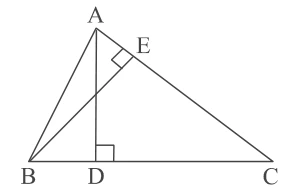
Q39. In △ABC, altitudes AD and BE are drawn. If AD = 7 cm, BE = 9 cm and EC = 12 cm, find the length of CD. [2 marks]

AD is perpendicular to BC and BE is perpendicular to AC. The lines meet outside the triangle as drawn.
CBSE question diagram.

Appeared in: 2024 · Standard · Main

Show answer and solution

∠ADC = ∠BEC = 90° and ∠ACD = ∠BCE.

Therefore △ADC ∼ △BEC by AA.

AD/BE = CD/CE.

7/9 = CD/12.

CD = 28/3 cm.

CD = 28/3 cm

Standard2 marks

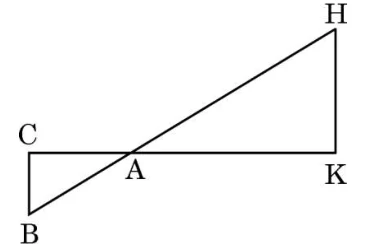
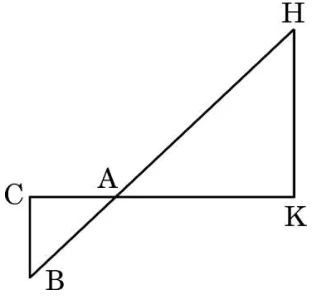
Q40. In the given figure, △AHK ∼ △ABC. If AK = 8 cm, BC = 3.2 cm and HK = 6.4 cm, find the length of AC. [2 marks]

C, A, K are collinear and B, A, H are collinear, forming similar triangles AHK and ABC.
CBSE question diagram.

Appeared in: 2024 · Standard · Main

Show answer and solution

Corresponding sides of similar triangles are proportional.

AK/AC = HK/BC.

8/AC = 6.4/3.2 = 2.

AC = 4 cm.

AC = 4 cm

Basic2 marks · Includes accessible-paper appearance

Q41. E and F are points on the sides PQ and PR respectively of △PQR and EF ∥ QR. If PE = 2.5 cm, PQ = 6 cm and PF = 4.5 cm, find the lengths of RF and PR. [2 marks]

Appeared in: 2024 · Basic · Supplementary

Show answer and solution

Since EF ∥ QR, PE/PQ = PF/PR.

2.5/6 = 4.5/PR.

PR = 10.8 cm.

RF = PR − PF = 10.8 − 4.5 = 6.3 cm.

RF = 6.3 cm; PR = 10.8 cm

Basic2 marks

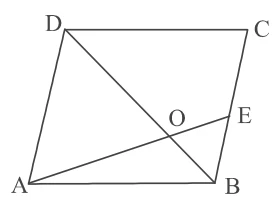
Q42. The diagonal BD of parallelogram ABCD is divided by segment AE in the ratio 1 : 2. If BE = 1.8 cm, find the length of AD. [2 marks]

E lies on BC of parallelogram ABCD; AE and diagonal BD meet at O.
CBSE question diagram.

Appeared in: 2025 · Basic · Main

Show answer and solution

Let AE meet BD at O. From the figure, BO/OD = 1/2.

Since BE ∥ AD, ∠OBE = ∠ODA and ∠BOE = ∠DOA.

Therefore △OBE ∼ △ODA.

BE/AD = BO/OD = 1/2.

AD = 2 × 1.8 = 3.6 cm.

AD = 3.6 cm

Basic2 marks

Q43. The perimeters of two similar triangles are 22 cm and 33 cm respectively. If one side of the first triangle is 9 cm, find the length of the corresponding side of the second triangle. [2 marks]

Appeared in: 2025 · Basic · Main

Show answer and solution

For similar triangles, the ratio of corresponding sides equals the ratio of perimeters.

9/x = 22/33.

x = 9 × 33/22 = 13.5 cm.

Corresponding side = 13.5 cm

Standard2 marks

Q44. (a) If △ABC ∼ △PQR in which AB = 6 cm, BC = 4 cm, AC = 8 cm and PR = 6 cm, find the length of (PQ + QR). [2 marks]

Show answer and solution

PQ/AB = QR/BC = PR/AC = 6/8 = 3/4.

PQ = (3/4) × 6 = 4.5 cm.

QR = (3/4) × 4 = 3 cm.

PQ + QR = 4.5 + 3 = 7.5 cm.

PQ + QR = 7.5 cm

OR

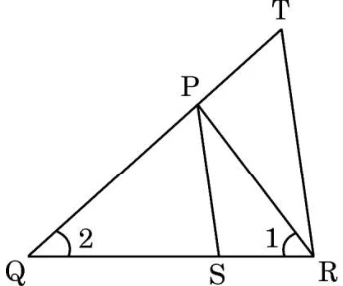
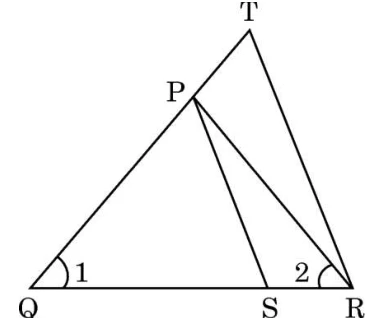
(b) In the given figure, QRQS = QTPR and ∠1 = ∠2. Prove that △PQS ∼ △TQR. [2 marks]

P lies on QT and S on QR; the marked angles PQR and PRQ are equal.
CBSE question diagram.

Appeared in: 2025 · Standard · Main

Show answer and solution

In △PQR, ∠PRQ = ∠PQR (given ∠1 = ∠2), so PR = PQ.

Given QR/QS = QT/PR, hence QS/QR = PR/QT = PQ/QT.

∠PQS = ∠TQR, since Q, S, R and Q, P, T are collinear.

Therefore △PQS ∼ △TQR by SAS similarity.

△PQS ∼ △TQR

Basic2 marks

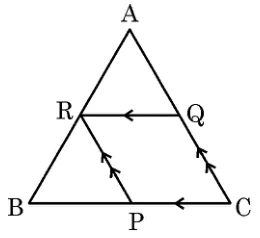
Q45. In the given figure, QR ∥ CB and RP ∥ AC. If BR = 10 cm, QA = 12 cm, BP = 12 cm and PC = 18 cm, find the lengths of AR and QC. [2 marks]

R lies on AB, Q on AC and P on BC. RQ is parallel to BC and RP is parallel to AC.
CBSE question diagram.

Appeared in: 2026 · Basic · Main

Show answer and solution

BC = BP + PC = 12 + 18 = 30 cm.

Since RP ∥ AC, △BRP ∼ △BAC, so BR/BA = BP/BC = 2/5.

BA = 25 cm, hence AR = 25 − 10 = 15 cm.

Since RQ ∥ BC, AQ/AC = AR/AB = 15/25 = 3/5.

AC = 20 cm, hence QC = 20 − 12 = 8 cm.

AR = 15 cm; QC = 8 cm

Basic2 marks

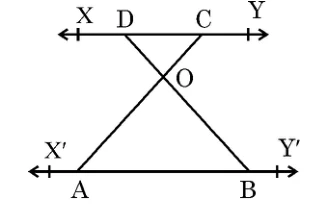
Q46. In the given figure, AB ∥ DC. If OB = 3OD and CD = 1.8 cm, find the length AB. [2 marks]

AB and DC are parallel; AC and BD intersect at O.
CBSE question diagram.

Appeared in: 2026 · Basic · Main

Show answer and solution

∠AOB = ∠COD and ∠ABO = ∠CDO.

Therefore △AOB ∼ △COD by AA.

AB/CD = OB/OD = 3.

AB = 3 × 1.8 = 5.4 cm.

AB = 5.4 cm

Basic2 marks

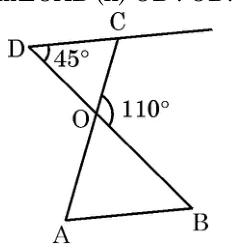
Q47. In the given figure, △ODC ∼ △OBA. If ∠BOC = 110°, ∠ODC = 45° and AB = 2CD, find (i) ∠OAB and (ii) OB : OD. [2 marks]

DC and AB lie above and below O. BOC is 110 degrees and ODC is 45 degrees.
CBSE question diagram.

Appeared in: 2026 · Basic · Main

Show answer and solution

∠DOC = 180° − 110° = 70° (linear pair).

∠OCD = 180° − 70° − 45° = 65°.

By similarity, ∠OAB = ∠OCD = 65°.

OB/OD = AB/CD = 2.

∠OAB = 65°; OB : OD = 2 : 1

Standard2 marks

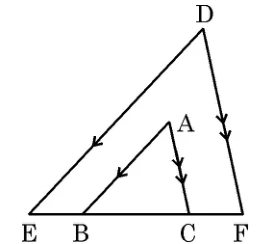
Q48. In the given figure, AB ∥ DE and AC ∥ DF. Show that △ABC ∼ △DEF. If BC = 10 cm, EB = CF = 5 cm and AB = 7 cm, find the length DE. [2 marks]

E, B, C, F are collinear; AB is parallel to DE and AC is parallel to DF.
CBSE question diagram.

Appeared in: 2026 · Standard · Main

Show answer and solution

∠ABC = ∠DEF and ∠ACB = ∠DFE (corresponding angles).

Thus △ABC ∼ △DEF by AA.

EF = EB + BC + CF = 5 + 10 + 5 = 20 cm.

AB/DE = BC/EF = 10/20 = 1/2.

DE = 14 cm.

△ABC ∼ △DEF; DE = 14 cm

Standard2 marks

Q49. (a) In △ABC, DE ∥ BC. If AD = x, DB = x − 2, AE = x + 2 and EC = x − 1, find x. [2 marks]

Show answer and solution

By BPT, AD/DB = AE/EC.

x/(x − 2) = (x + 2)/(x − 1).

x(x − 1) = (x + 2)(x − 2).

x² − x = x² − 4, so x = 4.

All four segment lengths are positive at x = 4.

x = 4

OR

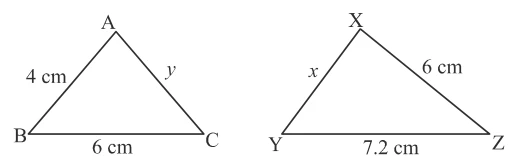
(b) In the figure, △ABC ∼ △XYZ. Find x and y. [2 marks]

Triangle ABC has AB 4 cm, BC 6 cm and AC y. Triangle XYZ has XY x, YZ 7.2 cm and XZ 6 cm.
CBSE question diagram.

Appeared in: 2026 · Standard · Main

Show answer and solution

From the diagram, AB = 4 cm, BC = 6 cm, AC = y, XY = x, YZ = 7.2 cm and XZ = 6 cm.

AB/XY = BC/YZ = AC/XZ (corresponding sides).

4/x = 6/7.2, so x = 4.8 cm.

y/6 = 6/7.2, so y = 5 cm.

x = 4.8 cm; y = 5 cm

Standard2 marks

Q50. (a) In the given figure, △AHK ∼ △ABC. If AK = 10 cm, BC = 3.5 cm and HK = 7 cm, find AC. [2 marks]

C, A, K and B, A, H are collinear; triangles AHK and ABC are similar.
CBSE question diagram.
Show answer and solution

By similarity, AK/AC = HK/BC.

10/AC = 7/3.5 = 2.

AC = 5 cm.

AC = 5 cm

OR

(b) In the given figure, XY ∥ QR, PQXQ = 73 and PR = 6.3 cm. Find YR. [2 marks]

X lies on PQ and Y lies on PR. XY is parallel to QR in triangle PQR.
CBSE question diagram.

Appeared in: 2026 · Standard · Main

Show answer and solution

By similarity, PX/PQ = PY/PR.

Subtracting from 1 gives XQ/PQ = YR/PR.

3/7 = YR/6.3.

YR = 2.7 cm.

YR = 2.7 cm

Shadows and similar-triangle applications

Basic2 marks

Q51. (a) A vertical pole of height 10 m casts a shadow of 15 m on the ground and at the same time a tower casts a shadow of 45 m. Find the height of the tower. [2 marks]

Show answer and solution

The pole and tower are vertical, and the Sun’s elevation is the same.

The two right triangles are similar by AA.

Height of tower/45 = 10/15.

Height of tower = 30 m.

Height of tower = 30 m

OR

(b) In the given figure, QRQS = QTPR and ∠1 = ∠2. Prove that △PQS ∼ △TQR. [2 marks]

P lies on QT and S lies on QR. The marked angles at Q and R of triangle PQR are equal.
CBSE question diagram.

Appeared in: 2025 · Basic · Main

Show answer and solution

In △PQR, ∠PRQ = ∠PQR (given ∠1 = ∠2), so PR = PQ.

Given QR/QS = QT/PR, hence QS/QR = PR/QT = PQ/QT.

∠PQS = ∠TQR, since Q, S, R and Q, P, T are collinear.

Therefore △PQS ∼ △TQR by SAS similarity.

△PQS ∼ △TQR

Standard2 marks

Q52. (a) A 1.5 m tall boy is walking away from the base of a lamp post which is 12 m high, at a speed of 2.5 m/s. Find the length of his shadow after 3 seconds. [2 marks]

Show answer and solution

Distance walked = speed × time = 2.5 × 3 = 7.5 m.

Let the shadow length be x m.

By similarity, 1.5/x = 12/(7.5 + x).

1.5(7.5 + x) = 12x, so 10.5x = 11.25.

x = 15/14 m.

Shadow length = 15/14 m

OR

(b) In parallelogram ABCD, side AD is produced to a point E and BE intersects CD at F. Prove that △ABE ∼ △CFB. [2 marks]

Appeared in: 2025 · Standard · Main

Show answer and solution

AB ∥ CD and AD ∥ BC (opposite sides of a parallelogram).

∠BAE = ∠FCB, since AE lies on AD and CF lies on CD.

∠ABE = ∠CFB, since B, F and E are collinear and AB ∥ CF.

Therefore △ABE ∼ △CFB by AA.

△ABE ∼ △CFB

Triangles: frequently asked questions

How do I choose between BPT and its converse?

Use BPT when a line is already known to be parallel to one side of a triangle and you need a side ratio. Use its converse when the side-division ratios are equal and you must prove the joining line parallel to the third side.

How do I write the correct order of similar triangles?

Match equal angles first. If angle A equals angle P, B equals Q and C equals R, write △ABC ∼ △PQR. The corresponding sides are AB with PQ, BC with QR, and AC with PR. Keep that order when forming ratios.

Can I use whole sides in a BPT question?

Yes, after establishing the correct relationship. If DE is parallel to BC, BPT gives AD/DB = AE/EC, while similarity gives AD/AB = AE/AC. Do not pair a divided segment on one side with an unrelated whole side on the other.

When can I use SAS similarity?

Use SAS similarity when two pairs of corresponding sides have the same ratio and the angles included between those side pairs are equal. A side-side ratio alone does not establish similarity. Name the equal included angles before writing the similarity conclusion.

Are similar triangles necessarily congruent?

No. Similar triangles have equal corresponding angles and proportional corresponding sides, but their sizes may differ. Congruent triangles are similar with a scale factor of 1. Two equilateral triangles of sides 2 cm and 4 cm are similar but not congruent.

Why can I compare a pole’s height with its shadow?

For vertical objects on level ground at the same time, the Sun’s elevation is the same. The two right triangles are therefore similar by AA, so the ratio of heights equals the ratio of shadow lengths. Use the same units throughout.

Does a median ratio follow from triangle similarity?

Yes. Corresponding medians of similar triangles are in the same ratio as corresponding sides. To prove it, use the midpoint property to halve the corresponding bases, establish similarity of the smaller triangles by SAS, and then compare the medians.

How much working should a 2-mark proof show?

State the angle equalities or side proportions, give their reasons, name the similarity criterion or BPT result, and write the required conclusion. A short proof still needs the logical link; a diagram that merely looks parallel or similar is insufficient.

Do I answer both OR alternatives?

Answer one alternative where an OR choice is printed. Both alternatives are solved here for practice. A full OR pair is one numbered question, while each alternative has its own worked solution and answer-summary entry.

Answer summary

Open the answer summary
QuestionAnswer
Q1DC ∥ AP
Q2AM/AN = AB/AD
Q3(a)OP × OR = OQ × OS
Q3(b) ORAM/AN = AB/AD
Q4EF is not parallel to QR
Q5AB = AC; △ABC is isosceles
Q6DC² = CF × AC
Q7(a)PQ = PR; △PQR is isosceles
Q7(b) OR△ADE ∼ △ABC
Q8(a)PQ is not parallel to EF
Q8(b) ORThe line joining the midpoints is parallel to the third side
Q9(a)△RPQ ∼ △RTS
Q9(b) ORAD/AB = AE/AC
Q10BF/FE = BE/EC
Q11(a)BD/DE = BE/EC
Q11(b) OR△ADE ∼ △ABC
Q12(a)XY ∥ QR
Q12(b) ORAD = 22.2 cm
Q13(a)AE/ED = BF/FC
Q13(b) OR∠ABC = 48°
Q14AC² = BC × DC
Q15△ABD ∼ △CBD; AB = BC
Q16(a)DE ∥ BC
Q16(b) ORPerimeter of △ABC = 18 cm
Q17(a)△POQ ∼ △SOR
Q17(b) OR∠OSR = 55°; ∠OQP = 55°
Q18△PDA ∼ △PBC
Q19OA/OC = OB/OD
Q20(a)OA/OC = OB/OD
Q20(b) ORPR² = QR × SR
Q21(a)CA² = CD × CB
Q21(b) OR∠A = ∠C; ∠B = ∠D
Q22△ABC ∼ △PQR
Q23△ACD ∼ △PRS
Q24△ABC ∼ △PQR
Q25△ADB ∼ △PSQ; AD × QS = BD × PS
Q26AG × DG = AF × DB
Q27ST × TQ = PT × TR
Q28△ADE ∼ △ABC
Q29(a)△ABD ∼ △CBE; △PDC ∼ △BEC
Q29(b) ORBF/FE = BE/EC
Q30△BAE ∼ △CAD
Q31OC = OA/2
Q32AB/DE = AP/DQ
Q33(a)AO/BO = CO/DO
Q33(b) ORPR = 12 cm
Q34(a)AO/BO = CO/DO
Q34(b) OR△BCD ∼ △ACB
Q35AQ = 4 cm
Q36BQ = 8 cm
Q37PM = 6 cm
Q38AB = 2CD
Q39CD = 28/3 cm
Q40AC = 4 cm
Q41RF = 6.3 cm; PR = 10.8 cm
Q42AD = 3.6 cm
Q43Corresponding side = 13.5 cm
Q44(a)PQ + QR = 7.5 cm
Q44(b) OR△PQS ∼ △TQR
Q45AR = 15 cm; QC = 8 cm
Q46AB = 5.4 cm
Q47∠OAB = 65°; OB : OD = 2 : 1
Q48△ABC ∼ △DEF; DE = 14 cm
Q49(a)x = 4
Q49(b) ORx = 4.8 cm; y = 5 cm
Q50(a)AC = 5 cm
Q50(b) ORYR = 2.7 cm
Q51(a)Height of tower = 30 m
Q51(b) OR△PQS ∼ △TQR
Q52(a)Shadow length = 15/14 m
Q52(b) OR△ABE ∼ △CFB

Both OR alternatives are listed for practice. The answer summary follows your selected filters.

How to write a 2-mark Triangles solution

  1. Identify what is required and follow any specified method.
  2. Match corresponding vertices and identify the theorem or criterion.
  3. Show one logical operation per line, keeping signs and brackets.
  4. Give reasons for angle equalities and conclude with the required proof or length, including units.

About these questions and solutions

Selected official CBSE 2-mark questions; exact repeated questions are merged, and complete OR pairings are retained.
Solutions prepared by Team TutorVertex in NCERT style, with the displayed answers compared with official marking-scheme working. How we check solutions.

Official sources — question papers and marking schemes

PDF pages are given for the displayed version. Repeat appearances are identified by paper code and question number. Archive member names identify the exact files inside official ZIPs. Question wording follows the first listed appearance; spacing and punctuation are normalised.

Question 1 sources

Question 2 sources

Question 3 sources

Question 4 sources

Question 5 sources

Question 6 sources

Question 7 sources

  • 2025 · Standard · Main · 30/2/3 · Q25Official question paper · PDF pp. 15, 17
    041_Mathematics_Standard/30-2-3_Mathematics Standard.pdf
    Official marking scheme · PDF p. 9
    Math/041 Mathematics Standard/X_MS_041_Mathematics Standard_30-2-3_2024-25.pdf

Question 8 sources

Question 9 sources

Question 10 sources

  • 2026 · Standard · Main · 30/4/2 · Q22Official question paper · PDF p. 13
    Mathematics_Standard/1171-2_30-4-2 (Mathematics Standard).pdf
    Official marking scheme · PDF p. 9
    041_MATHEMATICS STANDARD\MS_X_041_Mathematics_30-4-2_2025-26 (1).pdf

Question 11 sources

  • 2026 · Basic · Second board examination · 430/7/1 · Q21Official question paper · PDF pp. 13, 15
    Mathmatics_Basic/430-7-1_Maths Basic_E2_10_2026.pdf
    Official marking scheme · PDF p. 8
    Mathematics_Basic/Mathematisc Basic-241 E2 (430-7-1).pdf
  • 2026 · Basic · Second board examination · 430/7/2 · Q24Official question paper · PDF p. — see Q24
    Mathmatics_Basic/430-7-2_Maths Basic_E2_10_2026.pdf
    Official marking scheme · PDF p. — see Q24
    Mathematics_Basic/Mathematics Basic-241 E2 (430-7-2).pdf
  • 2026 · Basic · Second board examination · 430/7/3 · Q23Official question paper · PDF p. — see Q23
    Mathmatics_Basic/430-7-3_Maths Basic_E2_10_2026.pdf
    Official marking scheme · PDF p. — see Q23
    Mathematics_Basic/Mathematics Basic-241 E2 (430-7-3).pdf

Question 12 sources

  • 2026 · Standard · Second board examination · 30/7/1 · Q22Official question paper · PDF p. 15
    Mathmatics_Std/30-7-1_Maths Std_E2_10_2026.pdf
    Official marking scheme · PDF pp. 9, 10
    Mathematics_Standard/Mathematics Standard-041 E2 (Set 30-7-1).pdf
  • 2026 · Standard · Second board examination · 30/7/2 · Q21Official question paper · PDF p. — see Q21
    Mathmatics_Std/30-7-2_Maths Std_E2_10_2026.pdf
    Official marking scheme · PDF p. — see Q21
    Mathematics_Standard/Mathematics Standard-041 E2 (Set 30-7-2).pdf
  • 2026 · Standard · Second board examination · 30/7/3 · Q24Official question paper · PDF p. — see Q24
    Mathmatics_Std/30-7-3_Maths Std_E2_10_2026.pdf
    Official marking scheme · PDF p. — see Q24
    Mathematics_Standard/Mathematics Standard-041 E2 (Set 30-7-3).pdf

Question 13 sources

Question 14 sources

  • 2025 · Basic · Main · 430/2/1 · Q22Official question paper · PDF p. 11
    241_Mathematics_Basic/430-2-1_Mathematics Basic.pdf
    Official marking scheme · PDF p. 7
    Math/241 Mathematics Basic/X_241_Mathematics Basic_MS_430_2_1.pdf
  • 2025 · Basic · Main · 430/2/2 · Q25Official question paper · PDF p. — see Q25
    241_Mathematics_Basic/430-2-2_Mathematics Basic.pdf
    Official marking scheme · PDF p. — see Q25
    Math/241 Mathematics Basic/X_241_Mathematics Basic_MS_430_2_2.pdf
  • 2025 · Basic · Main · 430/2/3 · Q23Official question paper · PDF p. — see Q23
    241_Mathematics_Basic/430-2-3_Mathematics Basic.pdf
    Official marking scheme · PDF p. — see Q23
    Math/241 Mathematics Basic/X_241_Mathematics Basic_MS_430_2_3.pdf
  • 2026 · Standard · Main · 30/4/1 · Q22Official question paper · PDF p. — see Q22
    Mathematics_Standard/1171-1_30-4-1 (Mathematics Standard).pdf
    Official marking scheme · PDF p. — see Q22
    041_MATHEMATICS STANDARD\MS_X_041_Mathematics_30-4-1_2025-26 (1).pdf

Question 15 sources

Question 16 sources

Question 17 sources

  • 2025 · Basic · Main · 430/1/1 · Q22Official question paper · PDF p. 15
    241_Mathematics_Basic/430-1-1_Mathematics Basic.pdf
    Official marking scheme · PDF p. 8
    Math/241 Mathematics Basic/X_241_Mathematics Basic_MS_430_1_1.pdf
  • 2025 · Basic · Main · 430/1/2 · Q25Official question paper · PDF p. — see Q25
    241_Mathematics_Basic/430-1-2_Mathematics Basic.pdf
    Official marking scheme · PDF p. — see Q25
    Math/241 Mathematics Basic/X_241_Mathematics Basic_MS_430_1_2.pdf
  • 2025 · Basic · Main · 430/1/3 · Q23Official question paper · PDF p. — see Q23
    241_Mathematics_Basic/430-1-3_Mathematics Basic.pdf
    Official marking scheme · PDF p. — see Q23
    Math/241 Mathematics Basic/X_241_Mathematics Basic_MS_430_1_3.pdf

Question 18 sources

Question 19 sources

Question 20 sources

  • 2025 · Basic · Main · 430/B · Q23Official question paper · PDF p. 13
    241_Mathematics_Basic/430 B_Maths Basic for Visually Impaired candiddates.pdf
    Official marking scheme · PDF p. 8
    Math/241 Mathematics Basic/X_241_Mathematics Basic_MS_430 B.pdf

Question 21 sources

  • 2025 · Standard · Main · 30/2/1 · Q24Official question paper · PDF p. 15
    041_Mathematics_Standard/30-2-1_Mathematics Standard.pdf
    Official marking scheme · PDF pp. 8, 9
    Math/041 Mathematics Standard/X_MS_041_Mathematics Standard_30-2-1_2024-25.pdf
  • 2025 · Standard · Main · 30/2/2 · Q22Official question paper · PDF p. — see Q22
    041_Mathematics_Standard/30-2-2_Mathematics Standard.pdf
    Official marking scheme · PDF p. — see Q22
    Math/041 Mathematics Standard/X_MS_041_Mathematics Standard_30-2-2_2024-25.pdf

Question 22 sources

  • 2025 · Standard · Main · 30/5/1 · Q24Official question paper · PDF p. 13
    041_Mathematics_Standard/30-5-1_Mathematics Standard.pdf
    Official marking scheme · PDF pp. 7, 8
    Math/041 Mathematics Standard/X_MS_041_Mathematics Standard_30-5-1_2024-25.pdf

Question 23 sources

  • 2025 · Standard · Main · 30/5/2 · Q21Official question paper · PDF p. 13
    041_Mathematics_Standard/30-5-2_Mathematics Standard.pdf
    Official marking scheme · PDF p. 6
    Math/041 Mathematics Standard/X_MS_041_Mathematics Standard_30-5-2_2024-25.pdf

Question 24 sources

  • 2025 · Standard · Main · 30/5/3 · Q23Official question paper · PDF p. 13
    041_Mathematics_Standard/30-5-3_Mathematics Standard.pdf
    Official marking scheme · PDF p. 7
    Math/041 Mathematics Standard/X_MS_041_Mathematics Standard_30-5-3_2024-25.pdf

Question 25 sources

Question 26 sources

  • 2026 · Standard · Main · 30/4/3 · Q23Official question paper · PDF p. 13
    Mathematics_Standard/1171-3_30-4-3 (Mathematics Standard).pdf
    Official marking scheme · PDF p. 9
    041_MATHEMATICS STANDARD\MS_X_041_Mathematics_30-4-3_2025-26 (1).pdf

Question 27 sources

  • 2026 · Standard · Main · 30/3/2 · Q22Official question paper · PDF p. 15
    Mathematics_Standard/30_3_2_Mathematics Std._cl.10.pdf
    Official marking scheme · PDF p. 8
    041_MATHEMATICS STANDARD\MS_X_041_Mathematics_30-3-2_2025-26 (1).pdf

Question 28 sources

  • 2026 · Standard · Main · 30/3/3 · Q22Official question paper · PDF p. 15
    Mathematics_Standard/30_3_3_Mathematics Std._cl.10.pdf
    Official marking scheme · PDF p. 8
    041_MATHEMATICS STANDARD\MS_X_041_Mathematics_30-3-3_2025-26 (1).pdf

Question 29 sources

Question 30 sources

Question 31 sources

Question 32 sources

Question 33 sources

Question 34 sources

Question 35 sources

Question 36 sources

Question 37 sources

Question 38 sources

Question 39 sources

Question 40 sources

Question 41 sources

Question 42 sources

Question 43 sources

Question 44 sources

  • 2025 · Standard · Main · 30/1/1 · Q24Official question paper · PDF p. 15
    041_Mathematics_Standard/30-1-1_Mathematics Standard.pdf
    Official marking scheme · PDF pp. 8, 9
    Math/041 Mathematics Standard/X_MS_041_Mathematics Standard_30-1-1_2024-25.pdf
  • 2025 · Standard · Main · 30/1/2 · Q23Official question paper · PDF p. — see Q23
    041_Mathematics_Standard/30-1-2_Mathematics Standard.pdf
    Official marking scheme · PDF p. — see Q23
    Math/041 Mathematics Standard/X_MS_041_Mathematics Standard_30-1-2_2024-25.pdf
  • 2025 · Standard · Main · 30/1/3 · Q21Official question paper · PDF p. — see Q21
    041_Mathematics_Standard/30-1-3_Mathematics Standard.pdf
    Official marking scheme · PDF p. — see Q21
    Math/041 Mathematics Standard/X_MS_041_Mathematics Standard_30-1-3_2024-25.pdf

Question 45 sources

  • 2026 · Basic · Main · 430/4/1 · Q25Official question paper · PDF p. 15
    Mathematics_Standard/1158-1_430-4-1 Mathematics (Basic).pdf
    Official marking scheme · PDF p. 10
    241_MATHEMATICS BASIC\X_241_MS_430_4_1_unsigned.pdf
  • 2026 · Basic · Main · 430/4/2 · Q23Official question paper · PDF p. — see Q23
    Mathematics_Standard/1158-2_430-4-2 Mathematics (Basic).pdf
    Official marking scheme · PDF p. — see Q23
    241_MATHEMATICS BASIC\X_241_MS_430_4_2_unsigned.pdf
  • 2026 · Basic · Main · 430/4/3 · Q23Official question paper · PDF p. — see Q23
    Mathematics_Standard/1158-3_430-4-3 Mathematics (Basic).pdf
    Official marking scheme · PDF p. — see Q23
    241_MATHEMATICS BASIC\X_241_MS_430_4_3_unsigned.pdf

Question 46 sources

Question 47 sources

Question 48 sources

  • 2026 · Standard · Main · 30/5/1 · Q23Official question paper · PDF p. 15
    Mathematics_Standard/1172-1_30-5-1 (Mathematics Standard).pdf
    Official marking scheme · PDF pp. 8, 9
    041_MATHEMATICS STANDARD\MS_X_041_Mathematics_30-5-1_2025-26 (1).pdf
  • 2026 · Standard · Main · 30/5/2 · Q21Official question paper · PDF p. — see Q21
    Mathematics_Standard/1172-2_30-5-2 (Mathematics Standard).pdf
    Official marking scheme · PDF p. — see Q21
    041_MATHEMATICS STANDARD\MS_X_041_Mathematics_30-5-2_2025-26 (1).pdf
  • 2026 · Standard · Main · 30/5/3 · Q24Official question paper · PDF p. — see Q24
    Mathematics_Standard/1172-3_30-5-3 (Mathematics Standard).pdf
    Official marking scheme · PDF p. — see Q24
    041_MATHEMATICS STANDARD\MS_X_041_Mathematics_30-5-3_2025-26 (1).pdf

Question 49 sources

  • 2026 · Standard · Main · 30/1/1 · Q22Official question paper · PDF p. 7
    Mathematics_Standard/30-1-1P-Maths (Std)_X.pdf
    Official marking scheme · PDF pp. 7, 8
    041_MATHEMATICS STANDARD\MS_X_041_Mathematics_30-1-1_2025-26 (1).pdf
  • 2026 · Standard · Main · 30/1/2 · Q21Official question paper · PDF p. — see Q21
    Mathematics_Standard/30-1-2P-Maths (Std)_X.pdf
    Official marking scheme · PDF p. — see Q21
    041_MATHEMATICS STANDARD\MS_X_041_Mathematics_30-1-2_2025-26 (1).pdf
  • 2026 · Standard · Main · 30/1/3 · Q25Official question paper · PDF p. — see Q25
    Mathematics_Standard/30-1-3P-Maths (Std)_X.pdf
    Official marking scheme · PDF p. — see Q25
    041_MATHEMATICS STANDARD\MS_X_041_Mathematics_30-1-3_2025-26 (1).pdf

Question 50 sources

  • 2026 · Standard · Main · 30/2/1 · Q22Official question paper · PDF pp. 15, 17
    Mathematics_Standard/30_2_1_Mathematics Std._cl.10.pdf
    Official marking scheme · PDF pp. 8, 9
    041_MATHEMATICS STANDARD\MS_X_041_Mathematics_30-2-1_2025-26 (1).pdf
  • 2026 · Standard · Main · 30/2/2 · Q21Official question paper · PDF p. — see Q21
    Mathematics_Standard/30_2_2_Mathematics Std._cl.10.pdf
    Official marking scheme · PDF p. — see Q21
    041_MATHEMATICS STANDARD\MS_X_041_Mathematics_30-2-2_2025-26 (1).pdf
  • 2026 · Standard · Main · 30/2/3 · Q24Official question paper · PDF p. — see Q24
    Mathematics_Standard/30_2_3_Mathematics Std._cl.10.pdf
    Official marking scheme · PDF p. — see Q24
    041_MATHEMATICS STANDARD\MS_X_041_Mathematics_30-2-3_2025-26 (1).pdf

Question 51 sources

  • 2025 · Basic · Main · 430/3/1 · Q22Official question paper · PDF p. 13
    241_Mathematics_Basic/430-3-1_Mathematics Basic.pdf
    Official marking scheme · PDF p. 9
    Math/241 Mathematics Basic/X_241_Mathematics Basic_MS_430_3_1.pdf
  • 2025 · Basic · Main · 430/3/2 · Q25Official question paper · PDF p. — see Q25
    241_Mathematics_Basic/430-3-2_Mathematics Basic.pdf
    Official marking scheme · PDF p. — see Q25
    Math/241 Mathematics Basic/X_241_Mathematics Basic_MS_430_3_2.pdf
  • 2025 · Basic · Main · 430/3/3 · Q23Official question paper · PDF p. — see Q23
    241_Mathematics_Basic/430-3-3_Mathematics Basic.pdf
    Official marking scheme · PDF p. — see Q23
    Math/241 Mathematics Basic/X_241_Mathematics Basic_MS_430_3_3.pdf

Question 52 sources

  • 2025 · Standard · Main · 30/4/1 · Q22Official question paper · PDF p. 9
    041_Mathematics_Standard/30-4-1_Mathematics Standard.pdf
    Official marking scheme · PDF pp. 6, 7
    Math/041 Mathematics Standard/X_MS_041_Mathematics Standard _30-4-1_2024-25_.pdf
  • 2025 · Standard · Main · 30/4/2 · Q24Official question paper · PDF p. — see Q24
    041_Mathematics_Standard/30-4-2_Mathematics Standard.pdf
    Official marking scheme · PDF p. — see Q24
    Math/041 Mathematics Standard/X_MS_041_Mathematics Standard_30-4-2_2024-25_.pdf
  • 2025 · Standard · Main · 30/4/3 · Q21Official question paper · PDF p. — see Q21
    041_Mathematics_Standard/30-4-3_Mathematics Standard.pdf
    Official marking scheme · PDF p. — see Q21
    Math/041 Mathematics Standard/X_MS_041_Mathematics Standard_30-4-3_2024-25_.pdf

NCERT Class 10, Chapter 6: Triangles
CBSE Mathematics syllabus, 2026–27

Need help with Triangles?

Get one-to-one help with similarity proofs, proportional sides and clear exam working.

Book a Free Assessment →
TutorVertex · Master Maths. Build Confidence.