Coordinate Geometry 2-Mark Questions Class 10: CBSE PYQs with Answers
Practise 63 selected Coordinate Geometry questions worth 2 marks each, from CBSE Class 10 Basic and Standard board papers, and official sample papers. Use distance, midpoint and section formulae to find coordinates and prove geometric results. Try each question before opening its solution.
63 numbered questions · 102 board-paper appearances + 5 official-sample appearances 84 worked solutions, including both alternatives in 21 OR pairs By Siddharth Agrawal, Lead Maths Tutor, TutorVertex · Solutions prepared with Team TutorVertex Updated
Key results for Coordinate Geometry 2-mark questions
For A(x₁, y₁) and B(x₂, y₂):
Use
Result
Distance
AB = √((x₂ − x₁)² + (y₂ − y₁)²).
Midpoint
M = (, ).
Internal division
For AP : PB = m : n, P = (, ).
Axis intersections
Set y = 0 for the x-axis, or x = 0 for the y-axis.
Equidistant points
PA = PB implies PA² = PB².
Quadrilateral check
Use side lengths and the relevant diagonal or right-angle properties.
Which formula should I use?
Given
Starting point
A length or radius
Use the distance formula, keeping each negative coordinate in brackets.
A median or diameter
Find the midpoint first, then use distance if a length is required.
A division ratio or trisection point
Keep the endpoint order fixed and use the section formula.
Equal distances
Equate squared distances, then simplify.
A shape or collinearity proof
Compare side lengths; use the appropriate geometric converse.
No questions match these filters. Try another combination or reset the filters.
Distance formula, medians and radii
Standard2 marks
Q1. The vertices of a △ABC are A(−2, 4), B(4, 3) and C(1, −6). Find length of the median BD.
Appeared in: 2024 · Standard · Main
Show answer and solution
D is the midpoint of AC, so D = (, ) = (, −1).
BD = √((4 + )² + (3 + 1)²).
BD = √( + 16) = √().
BD = units
Standard2 marks
Q2. The coordinates of the centre of a circle are (2a, a − 7). Find the value(s) of a if the circle passes through the point (11, −9) and has diameter 10√2 units.
Appeared in: 2025 · Standard · Main
Show answer and solution
Radius = = 5√2.
By the distance formula, (2a − 11)² + (a + 2)² = 50.
5a² − 40a + 75 = 0.
a² − 8a + 15 = 0, so (a − 3)(a − 5) = 0.
a = 3 or 5
Standard2 marks
Q3. Find the length of the median through the vertex B of △ABC with vertices A(9, −2), B(−3, 7) and C(−1, 10).
Appeared in: 2025 · Standard · Main
Show answer and solution
Let M be the midpoint of AC.
M = (, ) = (4, 4).
BM = √((4 + 3)² + (4 − 7)²) = √(49 + 9).
Median BM = √58 units
Basic2 marks
Q4. (a) Find the values of a for which the distance between the points P(1, 2) and Q(−2, a) is 5 units.
Show answer and solution
PQ² = (−2 − 1)² + (a − 2)² = 25.
(a − 2)² = 16, so a − 2 = ±4.
a = 6 or −2
OR
(b) Find the coordinates of the point which divides the join of (4, −3) and (8, −5) in the ratio 3 : 1.
Appeared in: 2025 · Basic · Supplementary
Show answer and solution
By the section formula, P = (, ).
P = (, ).
P = (7, )
Standard2 marks
Q5. The coordinates of the centre of a circle are (x − 7, 2x). Find the value(s) of x, if the circle passes through the point (−9, 11) and has radius 5√2 units.
Appeared in: 2026 · Standard · Main
Show answer and solution
By the distance formula, (x − 7 + 9)² + (2x − 11)² = (5√2)².
(x + 2)² + (2x − 11)² = 50.
5x² − 40x + 75 = 0.
(x − 3)(x − 5) = 0.
x = 3 or 5
Standard2 marks
Q6. (a) Vertices of a right triangle ABC with ∠B = 90° are A(3, 4), B(1, 1) and C(−8, 7). Find the value of tan A.
Show answer and solution
AB = √((3 − 1)² + (4 − 1)²) = √13.
BC = √((−8 − 1)² + (7 − 1)²) = √117 = 3√13.
tan A = = .
tan A = 3
OR
(b) Using distance formula, prove that the points A(2, 3), B(−7, 0) and C(−1, 2) are collinear.
Appeared in: 2026 · Standard · Main
The full printed OR pair is retained; alternative (a) also uses trigonometry.
Show answer and solution
AC = √((−1 − 2)² + (2 − 3)²) = √10.
CB = √((−7 + 1)² + (0 − 2)²) = 2√10.
AB = √((−7 − 2)² + (0 − 3)²) = 3√10.
AC + CB = AB, so C lies on AB.
A, B and C are collinear.
Standard2 marks
Q7. Find the point(s) on the x-axis which is at a distance of √41 units from the point (8, −5).
Appeared in: 2024–25 · Standard · Official sample
Show answer and solution
Let P = (x, 0). By the distance formula, (x − 8)² + (0 + 5)² = 41.
(x − 8)² = 16, so x − 8 = ±4.
(4, 0) and (12, 0)
Basic2 marks
Q8. Find the radius of the circle whose end points of a diameter are (0, 0) and (6, 8).
Appeared in: 2025–26 · Basic · Official sample
Accessible alternative to the tangent-and-coordinate diagram question in the same sample.
Show answer and solution
Diameter = √((6 − 0)² + (8 − 0)²) = 10.
Radius = = .
Radius = 5 units
Standard2 marks
Q9. Find the points on the x-axis, each of which is at a distance of 10 units from the point A(11, −8).
Appeared in: 2023 · Standard · Main
Show answer and solution
Let P = (x, 0).
(x − 11)² + (0 + 8)² = 100.
(x − 11)² = 36, so x − 11 = ±6.
(5, 0) and (17, 0)
Standard2 marks
Q10. If the distance between the points (4, p) and (1, 0) is 5, what is the value of p?
Appeared in: 2026 · Standard · Main
Show answer and solution
By the distance formula, (4 − 1)² + (p − 0)² = 5².
9 + p² = 25, hence p² = 16.
p = ±4
Basic2 marks
Q11. A(−2, 3) and B(4, 1) are end points of the diameter of a semi-circle. The semi-circle intersects y-axis at point P. Find the co-ordinates of the point P.
Appeared in: 2026 · Basic · Main
Show answer and solution
The centre is the midpoint O = (, ) = (1, 2).
Radius² = OB² = (4 − 1)² + (1 − 2)² = 10.
Let P = (0, y). Then OP² = 1 + (y − 2)² = 10.
(y − 2)² = 9, so y = 5 or −1.
The printed question does not specify which half-circle; the marking scheme lists both possible intersections.
P = (0, 5) or (0, −1)
Basic2 marks
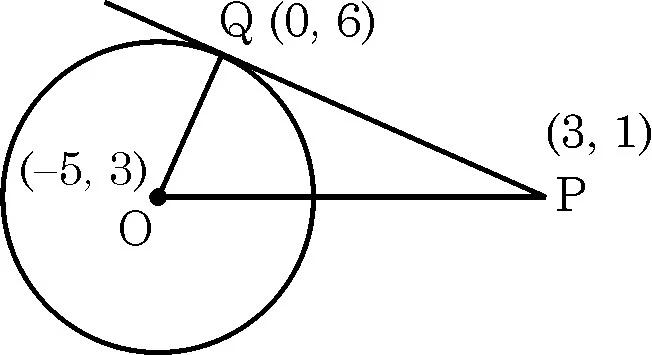
Q12. In the given figure, PQ is a tangent to a circle with centre O(−5, 3). If coordinates of P and Q are (3, 1) and (0, 6) respectively, then using distance formula, show that PQ ⟂ OQ.
CBSE question diagram.
Appeared in: 2026 · Basic · Main
Show answer and solution
PQ² = (3 − 0)² + (1 − 6)² = 34.
OQ² = (−5 − 0)² + (3 − 6)² = 34.
OP² = (3 + 5)² + (1 − 3)² = 68.
PQ² + OQ² = OP², so ∠PQO = 90° by the converse of Pythagoras theorem.
PQ ⟂ OQ
Standard2 marks
Q13. If AOBC is rectangle whose vertices are A(0, 3), O(0, 0), B(5, 0) and C(5, 3), then find the length of its diagonal.
Appeared in: 2026 · Standard · Second board examination
Show answer and solution
A diagonal joins A to B.
AB = √((5 − 0)² + (0 − 3)²) = √(25 + 9).
Diagonal = √34 units
Section formula, trisection and axis intersections
Basic2 marks
Q14. (a) Find the coordinates of the point which divides the line segment joining the points (7, −1) and (−3, 4) internally in the ratio 2 : 3.
Show answer and solution
For AP : PB = m : n, P = (, ).
P = (, ).
P = (, ).
P = (3, 1)
OR
(b) Find the value(s) of y for which the distance between the points A(3, −1) and B(11, y) is 10 units.
Appeared in: 2023 · Basic · Main
Show answer and solution
AB² = (11 − 3)² + (y + 1)².
100 = 64 + (y + 1)².
y + 1 = ±6.
y = 5 or −7
Standard2 marks
Q15. (a) The line segment joining the points A(4, −5) and B(4, 5) is divided by the point P such that AP : AB = 2 : 5. Find the coordinates of P.
Show answer and solution
AP : PB = 2 : (5 − 2) = 2 : 3.
By the section formula, P = (, ).
P = (, ).
P = (4, −1)
OR
(b) Point P(x, y) is equidistant from points A(5, 1) and B(1, 5). Prove that x = y.
Appeared in: 2023 · Standard · Main
Show answer and solution
PA = PB, so (x − 5)² + (y − 1)² = (x − 1)² + (y − 5)².
−10x − 2y + 26 = −2x − 10y + 26.
8y = 8x.
x = y
Standard2 marks
Q16. Find the ratio in which y-axis divides the line segment joining the points (5, −6) and (−1, −4).
Appeared in: 2023 · Standard · Main
Show answer and solution
Let AP : PB = m : n. On the y-axis, the x-coordinate is 0.
By the section formula, = 0.
m = 5n.
AP : PB = 5 : 1
Standard2 marks
Q17. Find the ratio in which line y = x divides the line segment joining the points (6, −3) and (1, 6).
Appeared in: 2023 · Standard · Main
Show answer and solution
Let AP : PB = m : n.
By the section formula, P = (, ).
Since y = x, m + 6n = 6m − 3n.
5m = 9n.
AP : PB = 9 : 5
Basic2 marks
Q18. (a) Find the coordinates of the point which divides the join of A(−1, 7) and B(4, −3) in the ratio 2 : 3.
Show answer and solution
By the section formula, P = (, ).
P = (, ).
P = (1, 3)
OR
(b) If the points A(2, 3), B(−5, 6), C(6, 7) and D(p, 4) are the vertices of a parallelogram ABCD, find the value of p.
Appeared in: 2023 · Basic · Main
Show answer and solution
The diagonals of a parallelogram bisect each other.
Midpoint of AC = (, ) = (4, 5).
Midpoint of BD = (, ).
= 4.
p = 13
Basic2 marks
Q19. Find the ratio in which a line segment joining points (1, −4) and (6, 5) is divided by the x-axis.
Appeared in: 2023 · Basic · Supplementary
Show answer and solution
Let AP : PB = m : n. On the x-axis, y = 0.
By the section formula, = 0.
5m = 4n.
AP : PB = 4 : 5
Basic2 marks
Q20. Find the ratio in which the point P(m, 6) divides the line segment joining A(−4, 3) and B(2, 8). Also, find the value of m.
Appeared in: 2023 · Basic · Supplementary
Show answer and solution
Let AP : PB = k : 1.
6 = , so 6k + 6 = 8k + 3.
k = , hence AP : PB = 3 : 2.
m = .
AP : PB = 3 : 2; m =
Basic2 marks
Q21. Find the ratio in which a line segment joining the points (−1, 1) and (5, 4) is divided by the y-axis.
Appeared in: 2023 · Basic · Supplementary
Show answer and solution
Let AP : PB = m : n. On the y-axis, x = 0.
= 0.
n = 5m.
AP : PB = 1 : 5
Standard2 marks
Q22. Find the ratio in which the point (−1, k) divides the line segment joining the points (−3, 10) and (6, −8). Hence, find the value of k.
Appeared in: 2023 · Standard · Supplementary
Show answer and solution
Let AP : PB = m : n.
−1 = , so 7m = 2n.
AP : PB = 2 : 7.
k = = 6.
Ratio = 2 : 7; k = 6
Basic2 marks
Q23. Find the ratio in which the Y-axis divides the line segment joining the points A(5, −6) and B(−1, −4). Also, find the point of intersection.
Appeared in: 2024 · Basic · Main
Show answer and solution
Let AP : PB = m : n. On the y-axis, x = 0.
= 0, so m : n = 5 : 1.
y = = .
Ratio = 5 : 1; intersection = (0, )
Basic2 marks
Q24. Point P(x, y) divides the line segment joining the points A(−1, 3) and B(9, 8) such that AP : PB = k : 1. If the co-ordinates of P are such that x = y, then find the value of k.
Appeared in: 2024 · Basic · Main
Show answer and solution
By the section formula, x = and y = .
Since x = y, 9k − 1 = 8k + 3.
k = 4
Basic2 marks
Q25. (a) Find the ratio in which the point (3, y), divides the line segment joining the points (−2, −5) and (6, 3). Also, find the value of y.
Show answer and solution
Let AP : PB = m : n.
3 = , so 3m = 5n.
AP : PB = 5 : 3.
y = = 0.
Ratio = 5 : 3; y = 0
OR
(b) Find a point on y-axis which is equidistant from the points A(6, 5) and B(−4, 3).
Appeared in: 2024 · Basic · Main
Show answer and solution
Let P = (0, y). Since PA = PB, 36 + (y − 5)² = 16 + (y − 3)².
61 − 10y = 25 − 6y.
4y = 36.
P = (0, 9)
Standard2 marks
Q26. (a) In what ratio is the line segment joining the points (3, −5) and (−1, 6) divided by the line y = x?
Show answer and solution
Let AP : PB = m : n.
P = (, ).
Since x = y, −m + 3n = 6m − 5n.
7m = 8n.
AP : PB = 8 : 7
OR
(b) A(3, 0), B(6, 4) and C(−1, 3) are vertices of a triangle ABC. Find length of its median BE.
Appeared in: 2024 · Standard · Main
Show answer and solution
E is the midpoint of AC, so E = (, ) = (1, ).
BE = √((6 − 1)² + (4 − )²).
BE = √(25 + ) = √().
BE = units
Standard2 marks
Q27. (a) Find the ratio in which the point P(−4, 6) divides the line segment joining the points A(−6, 10) and B(3, −8).
Show answer and solution
Let AP : PB = m : n.
−4 = , so 7m = 2n.
The y-coordinate check gives = 6.
AP : PB = 2 : 7
OR
(b) Prove that the points (3, 0), (6, 4) and (−1, 3) are the vertices of an isosceles triangle.
Appeared in: 2024 · Standard · Main
Show answer and solution
Let the points be A, B and C.
AB² = (6 − 3)² + (4 − 0)² = 25.
AC² = (−1 − 3)² + (3 − 0)² = 25.
AB = AC = 5, hence the triangle is isosceles.
The triangle is isosceles.
Basic2 marks
Q28. Find the coordinates of the points of trisection of line segment joining the points (−4, 1) and (6, 5).
Appeared in: 2025 · Basic · Main
Show answer and solution
The trisection points divide AB in the ratios 1 : 2 and 2 : 1.
P = (, ) = (, ).
Q = (, ) = (, ).
(, ) and (, )
Basic2 marks
Q29. Point P(x, 0) divides the line segment joining the points (2, 8) and (−3, −5) in a certain ratio. Find the ratio and hence find the value of x.
Appeared in: 2025 · Basic · Main
Show answer and solution
Let AP : PB = m : n.
0 = , so m : n = 8 : 5.
x = = .
Ratio = 8 : 5; x =
Basic2 marks
Q30. Find the ratio in which point P(−1, m) divides the line segment joining the points A(2, 5) and B(−5, −2). Hence, find the value of m.
Appeared in: 2025 · Basic · Main
Show answer and solution
Let AP : PB = k : 1.
−1 = , so 4k = 3.
AP : PB = 3 : 4.
m = = 2.
Ratio = 3 : 4; m = 2
Basic2 marks
Q31. Find the ratio in which the segment joining the points (2, −5) and (5, 3) is divided by x-axis. Also, find coordinates of the point on x-axis.
Appeared in: 2025 · Basic · Main
Show answer and solution
Let AP : PB = m : n.
0 = , so m : n = 5 : 3.
x = = .
Ratio = 5 : 3; point = (, 0)
Standard2 marks
Q32. Find the coordinates of the point C which lies on the line AB produced such that AC = 2BC, where coordinates of points A and B are (−1, 7) and (4, −3) respectively.
Appeared in: 2025 · Standard · Main
Show answer and solution
Since C lies beyond B, AC = AB + BC.
Given AC = 2BC, so AB = BC; B is the midpoint of AC.
4 = and −3 = .
x = 9 and y = −13.
C = (9, −13)
Standard2 marks
Q33. The coordinates of the end points of the line segment AB are A(−2, −2) and B(2, −4). P is the point on AB such that BP = AB. Find the coordinates of point P.
Appeared in: 2025 · Standard · Main
Show answer and solution
AP = AB − BP = ()AB, so AP : PB = 3 : 4.
P = (, ).
P = (, ).
P = (, )
Basic2 marks
Q34. (a) Find the coordinates of the point which divides the join of (−1, 7) and (4, −3) in the ratio 2 : 3.
(b) Using distance formula, prove that the points A(3, 1), B(6, 4) and C(8, 6) are collinear.
Appeared in: 2025 · Basic · Supplementary
Show answer and solution
AB = √((6 − 3)² + (4 − 1)²) = 3√2.
BC = √((8 − 6)² + (6 − 4)²) = 2√2.
AC = √((8 − 3)² + (6 − 1)²) = 5√2.
AB + BC = AC, so B lies on AC.
A, B and C are collinear.
Basic2 marks
Q35. The vertices of a △ABC are A(−1, 3), B(2, −3) and C(4, 5). Find the coordinates of a point P on median AD such that AP : PD = 2 : 3.
Appeared in: 2026 · Basic · Main
Show answer and solution
D is the midpoint of BC, so D = (, ) = (3, 1).
By the section formula, P = (, ).
P = (, ).
P = (, )
Standard2 marks
Q36. Find the coordinates of the point R which lies on the line PQ produced such that PR = 2QR, where coordinates of points P and Q are (7, −1) and (−3, 4) respectively.
Appeared in: 2026 · Standard · Second board examination
Show answer and solution
R lies beyond Q, so PR = PQ + QR.
Given PR = 2QR, hence PQ = QR and Q is the midpoint of PR.
−3 = and 4 = .
x = −13 and y = 9.
R = (−13, 9)
Standard2 marks
Q37. Find the coordinates of the point which divides the line segment joining (−1, 3) and (4, −7) internally in the ratio 3 : 4.
Appeared in: 2026 · Standard · Second board examination
Show answer and solution
By the section formula, P = (, ).
P = (, ).
P = (, )
Standard2 marks
Q38. Find the co-ordinates of point A, where AB is diameter of the circle whose centre is (2, −3) and B is (1, 4).
Appeared in: 2026 · Standard · Second board examination
Show answer and solution
Let A = (x, y). The centre is the midpoint of AB.
= 2 and = −3.
x = 3 and y = −10.
A = (3, −10)
Equidistant points and coordinate relations
Basic2 marks
Q39. (a) Find the value(s) of x so that PQ = QR, where the coordinates of P, Q and R are (6, −1), (1, 3) and (x, 8) respectively.
Show answer and solution
By the distance formula, PQ² = (6 − 1)² + (−1 − 3)² = 41.
QR² = (x − 1)² + (8 − 3)² = (x − 1)² + 25.
PQ = QR gives (x − 1)² = 16.
x − 1 = ±4.
x = 5 or −3
OR
(b) The vertices of a triangle are (−2, 0), (2, 3) and (1, −3). Is the triangle equilateral, isosceles or scalene?
Appeared in: 2023 · Basic · Main
Show answer and solution
Let the points be A, B and C respectively.
AB² = (2 + 2)² + (3 − 0)² = 25.
BC² = (1 − 2)² + (−3 − 3)² = 37.
CA² = (−2 − 1)² + (0 + 3)² = 18.
All three side lengths are different.
Scalene triangle
Basic2 marks · Includes accessible-paper appearance
Q40. (a) Find the positive value of y for which the distance between the points A(3, −1) and B(11, y) is 10 units.
Show answer and solution
By the distance formula, (11 − 3)² + (y + 1)² = 10².
(y + 1)² = 36, so y = 5 or −7.
The required value is positive.
y = 5
OR
(b) Find the ratio in which y-axis divides the line segment joining the points A(5, −6) and B(−1, −4).
(b) Points A(−1, y) and B(5, 7) lie on a circle with centre O(2, −3y) such that AB is a diameter of the circle. Find the value of y. Also, find the radius of the circle.
Appeared in: 2024 · Standard · Main
Show answer and solution
The centre is the midpoint of AB, so −3y = .
−6y = y + 7, hence y = −1.
O = (2, 3) and A = (−1, −1).
Radius OA = √((2 + 1)² + (3 + 1)²) = 5.
y = −1; radius = 5 units
Basic2 marks
Q45. Establish a relation between x and y such that point (x, y) is equidistant from points (−2, 5) and (3, 9).
Q46. Prove that abscissa of a point P which is equidistant from points with coordinates A(7, 1) and B(3, 5) is 2 more than its ordinate.
Same coordinate relation as Q44(a); expressed using abscissa and ordinate.
Appeared in: 2025 · Standard · Main
Show answer and solution
Let P = (x, y). Since PA = PB, (x − 7)² + (y − 1)² = (x − 3)² + (y − 5)².
−14x − 2y + 50 = −6x − 10y + 34.
8x − 8y = 16, hence x = y + 2.
The abscissa is 2 more than the ordinate.
Standard2 marks
Q47. Find the coordinates of a point P on x-axis equidistant from the points A(−1, 0) and B(5, 0), using distance formula.
Appeared in: 2026 · Standard · Second board examination
Show answer and solution
Let P = (x, 0). Since PA = PB, (x + 1)² = (x − 5)².
2x + 1 = −10x + 25.
12x = 24.
P = (2, 0)
Basic2 marks
Q48. (a) If A(a, b) is a point which is equidistant from points B(2, 4) and C(−2, −3), then find the relation between a and b.
Show answer and solution
AB² = AC² gives (a − 2)² + (b − 4)² = (a + 2)² + (b + 3)².
−4a − 8b + 20 = 4a + 6b + 13.
8a + 14b = 7
OR
(b) Find the ratio in which the line x + 3y = 12 divides the line segment joining (1, 3) and (2, 5).
Appeared in: 2026 · Basic · Second board examination
Show answer and solution
Let AP : PB = m : n.
P = (, ).
Since x + 3y = 12, 2m + n + 15m + 9n = 12m + 12n.
5m = 2n.
AP : PB = 2 : 5
Basic2 marks
Q49. (a) P(x, y) is a point equidistant from the points A(4, 3) and B(3, 4). Prove that x − y = 0.
Show answer and solution
PA = PB, so (x − 4)² + (y − 3)² = (x − 3)² + (y − 4)².
−8x − 6y + 25 = −6x − 8y + 25.
2x = 2y.
x − y = 0
OR
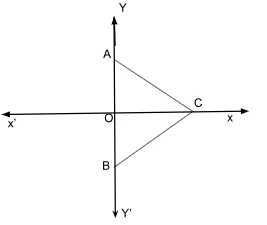
(b) In the given figure, △ABC is an equilateral triangle. Coordinates of vertices A and B are (0, 3) and (0, −3) respectively. Find the coordinates of points C.
CBSE question diagram.
Appeared in: 2024–25 · Basic · Official sample
Show answer and solution
The midpoint of AB is M(0, 0), and AB = 6.
In an equilateral triangle, CM is perpendicular to AB and AM = 3.
CM² = CA² − AM² = 36 − 9 = 27.
In the given figure, C is on the positive x-axis, so its x-coordinate is 3√3.
C = (3√3, 0)
Triangle types, collinearity and quadrilateral proofs
Standard2 marks
Q50. Show that the points (−2, 3), (8, 3) and (6, 7) are the vertices of a right-angled triangle.
Appeared in: 2023 · Standard · Main
Show answer and solution
Let the points be A, B and C respectively.
AB² = (8 + 2)² + (3 − 3)² = 100.
BC² = (6 − 8)² + (7 − 3)² = 20.
CA² = (−2 − 6)² + (3 − 7)² = 80.
BC² + CA² = AB², so ∠C = 90° by the converse of Pythagoras theorem.
The triangle is right-angled at (6, 7).
Basic2 marks
Q51. (a) Show that A(1, 2), B(5, 4), C(3, 8) and D(−1, 6) are vertices of a parallelogram ABCD.
Show answer and solution
Midpoint of AC = (, ) = (2, 5).
Midpoint of BD = (, ) = (2, 5).
The diagonals bisect each other, so ABCD is a parallelogram.
ABCD is a parallelogram.
OR
(b) Show that the points A(3, 0), B(6, 4) and C(−1, 3) are vertices of a right-angled triangle.
Same vertices as Q27(b); this version asks for a right-angle proof.
Appeared in: 2023 · Basic · Main
Show answer and solution
AB² = (6 − 3)² + (4 − 0)² = 25.
AC² = (−1 − 3)² + (3 − 0)² = 25.
BC² = (−1 − 6)² + (3 − 4)² = 50.
AB² + AC² = BC², so ∠A = 90° by the converse of Pythagoras theorem.
△ABC is right-angled at A.
Standard2 marks
Q52. (a) Show that the points (−3, −3), (3, 3) and (−3√3, 3√3) are the vertices of an equilateral triangle.
Show answer and solution
Let the points be A, B and C.
AB² = (3 + 3)² + (3 + 3)² = 72.
AC² = (3 − 3√3)² + (3 + 3√3)² = 72.
BC² = (−3√3 − 3)² + (3√3 − 3)² = 72.
AB = BC = CA = 6√2.
The triangle is equilateral.
OR
(b) Prove that A(4, 3), B(6, 4), C(5, 6), D(3, 5) are the vertices of a square ABCD.
Appeared in: 2023 · Standard · Supplementary
Show answer and solution
By the distance formula, AB² = BC² = CD² = DA² = 5.
AC² = (5 − 4)² + (6 − 3)² = 10.
BD² = (3 − 6)² + (5 − 4)² = 10.
The four sides are equal and the diagonals are equal; hence ABCD is a square.
ABCD is a square.
Standard2 marks
Q53. (a) If A(−2, −1), B(a, 0), C(4, b) and D(1, 2) are the vertices of a parallelogram ABCD, then find the values of a and b.
Show answer and solution
Diagonals AC and BD have the same midpoint.
= , so a = 1.
= , so b = 3.
a = 1; b = 3
OR
(b) The three vertices of a parallelogram ABCD, taken in order, are A(−1, 0), B(3, 1) and C(2, 2). Find the coordinates of the fourth vertex D.
Appeared in: 2023 · Standard · Supplementary
Show answer and solution
Let D = (x, y). The diagonals bisect each other.
= , so x = −2.
= , so y = 1.
D = (−2, 1)
Standard2 marks
Q54. Find the type of triangle ABC formed whose vertices are A(1, 0), B(−5, 0) and C(−2, 5).
Appeared in: 2024 · Standard · Main
Show answer and solution
AB² = (−5 − 1)² = 36.
BC² = (−2 + 5)² + 5² = 34.
CA² = (1 + 2)² + (0 − 5)² = 34.
BC = CA = √34.
△ABC is isosceles.
Basic2 marks
Q55. Using distance formula, prove that the points (1, 5), (2, 3) and (3, 1) are collinear.
Appeared in: 2025 · Basic · Main
Show answer and solution
Let the points be A, B and C.
AB = √((2 − 1)² + (3 − 5)²) = √5.
BC = √((3 − 2)² + (1 − 3)²) = √5.
AC = √((3 − 1)² + (1 − 5)²) = 2√5.
AB + BC = AC; hence B lies on AC.
The three points are collinear.
Standard2 marks · Includes accessible-paper appearance
Q56. Show that the points (a, a), (−a, −a) and (−√3a, √3a) are the vertices of an equilateral triangle.
Appeared in: 2025 · Standard · Supplementary
Show answer and solution
Let the points be A, B and C.
AB² = (−2a)² + (−2a)² = 8a².
AC² = (−√3a − a)² + (√3a − a)² = 8a².
BC² = (−√3a + a)² + (√3a + a)² = 8a².
For a ≠ 0, all three sides have the same positive length. If a = 0, the points coincide.
Equilateral for a ≠ 0.
Standard2 marks
Q57. Show that the points A(−5, 6), B(3, 0) and C(9, 8) are the vertices of an isosceles triangle.
Appeared in: 2024–25 · Standard · Official sample
Show answer and solution
AB² = (3 + 5)² + (0 − 6)² = 100.
BC² = (9 − 3)² + (8 − 0)² = 100.
AC² = (9 + 5)² + (8 − 6)² = 200.
AB = BC = 10.
△ABC is isosceles.
Basic2 marks
Q58. (a) Points A(3, 1), B(5, 1), C(a, b) and D(4, 3) are vertices of a parallelogram ABCD. Find the values of a and b.
Show answer and solution
The diagonals of a parallelogram bisect each other.
Midpoint of AC = (, ).
Midpoint of BD = (, ) = (, 2).
3 + a = 9 and 1 + b = 4.
a = 6; b = 3
OR
(b) Find a linear relation between x and y such that P(x, y) is equidistant from the points A(1, 4) and B(−1, 2).
Q59. Using distance formula, show that the points (−1, 3), (6, 2) and (3, −1) are vertices of a right-angled triangle.
Appeared in: 2025 · Basic · Main
Show answer and solution
Let the points be A, B and C.
AB² = (6 + 1)² + (2 − 3)² = 50.
BC² = (3 − 6)² + (−1 − 2)² = 18.
AC² = (3 + 1)² + (−1 − 3)² = 32.
BC² + AC² = AB², so ∠C = 90° by the converse of Pythagoras theorem.
The triangle is right-angled at (3, −1).
Standard2 marks
Q60. Do the points P(1, 0), Q(−5, 0) and R(−2, 5) form a triangle? If so, name the type of triangle formed.
Same coordinates as Q54; this version also checks whether a triangle is formed.
Appeared in: 2026 · Standard · Main
Show answer and solution
PQ = √((−5 − 1)² + (0 − 0)²) = 6.
PR = √((−2 − 1)² + 5²) = √34.
QR = √((−2 + 5)² + 5²) = √34.
The triangle inequalities hold, including 2√34 > 6.
PR = QR, so the triangle is isosceles.
Yes; an isosceles triangle.
Standard2 marks
Q61. If the points A(4, 5), B(m, 6), C(4, 3) and D(1, n) taken in this order are the vertices of a parallelogram ABCD, then find the values of m and n.
Appeared in: 2026 · Standard · Main
Show answer and solution
The diagonals bisect each other.
Midpoint of AC = (, ) = (4, 4).
Midpoint of BD = (, ).
m + 1 = 8 and 6 + n = 8.
m = 7; n = 2
Standard2 marks
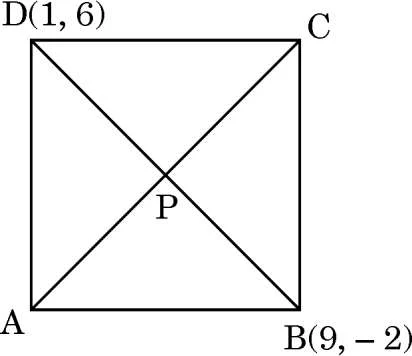
Q62. (a) Diagonals AC and BD of square ABCD intersect at P. Coordinates of points B and D are (9, −2) and (1, 6) respectively. (i) Find the co-ordinates of point P. (ii) Find the length of the side of the square.
CBSE question diagram.Show answer and solution
(i) The diagonals bisect each other, so P is the midpoint of BD.
P = (, ) = (5, 2).
(ii) BD² = (9 − 1)² + (−2 − 6)² = 128.
For a square, BD² = 2AB², hence AB² = 64.
(i) P = (5, 2); (ii) side = 8 units
OR
(b) Find the coordinates of a point on the line x + y = 5 which is equidistant from (6, 4) and (5, 2).
Appeared in: 2026 · Standard · Main
Show answer and solution
Let P = (x, y). Equal squared distances give (x − 6)² + (y − 4)² = (x − 5)² + (y − 2)².
2x + 4y = 23, so x + 2y = .
Subtract x + y = 5 to get y = .
x = 5 − = .
P = (, )
Standard2 marks
Q63. If points A(1, 2), B(4, y), C(x, 6) and D(3, 5) are the vertices of a parallelogram ABCD, then find values of x and y.
Appeared in: 2026 · Standard · Second board examination
Show answer and solution
The diagonals AC and BD have the same midpoint.
= , so x = 6.
= , so y = 3.
x = 6; y = 3
Coordinate Geometry: frequently asked questions
What is the distance formula for two points?
For A(x₁, y₁) and B(x₂, y₂), AB = √((x₂ − x₁)² + (y₂ − y₁)²). Substitute each coordinate with its sign. The squared terms are added, so the distance is non-negative.
How do I use the section formula without reversing the ratio?
For AP : PB = m : n, multiply B’s coordinates by m and A’s coordinates by n, then divide their sums by m + n. Keep the names A and B fixed. For a midpoint, m = n = 1.
How do I find where an axis divides a line segment?
Let the division ratio be m : n and write the section-formula coordinates. Set y = 0 for the x-axis or x = 0 for the y-axis. Solve for m : n, then substitute it to find the other coordinate if asked.
What is the difference between AP : AB and AP : PB?
AB is the whole segment, while PB is its remaining part. If AP : AB = 2 : 5, then PB corresponds to 5 − 2 = 3 parts, so AP : PB = 2 : 3. Convert to the divided-segment ratio before using the section formula.
How do I find the length of a median?
A median joins a vertex to the midpoint of the opposite side. First use the midpoint formula to find that point. Then apply the distance formula between the vertex and the midpoint. Do not use the opposite side’s full endpoint coordinates as the median’s endpoint.
How can I prove three points are collinear using distance?
Find the three pairwise distances and identify the largest. If the sum of the two smaller distances equals the largest, the points are collinear and the middle point lies between the other two. Use exact values rather than rounded decimals for the equality.
Are equal sides enough to prove that a quadrilateral is a square?
No. Four equal sides establish a rhombus, which need not be a square. Also establish a right angle or equal diagonals. For a rectangle, show the relevant parallelogram property and a right angle or equal diagonals.
Can an equidistant-point question have more than one answer?
Yes. Points equidistant from two distinct points lie on their perpendicular bisector, so infinitely many exist unless another condition is given. A condition such as lying on an axis can restrict the answer. Keep both values when both satisfy the original question.
How do I prove a parallelogram using coordinates?
Find the midpoint of each diagonal. If the two midpoints coincide, the diagonals bisect each other, so the quadrilateral is a parallelogram. Keep the vertices in the stated order: in ABCD, compare the midpoints of AC and BD.
Do I answer both OR alternatives?
Answer one alternative where an OR choice is printed. Both alternatives are solved here for practice. A full OR pair is one numbered question, while each alternative has its own worked solution and answer-summary entry.
Exact repeats of full question groups are merged; original OR pairs are retained, so a subquestion can recur in another pair. Solutions prepared by Team TutorVertex in NCERT style, with source references supplied for checking against the official marking schemes. How we check solutions.
Official sources — question papers and marking schemes
PDF pages are given for the displayed version. Repeat appearances are identified by paper code and question number. Archive member names identify the exact files inside official ZIPs. Question wording follows the first listed appearance; spacing and punctuation are normalised.
Question 1 sources
2024 · Standard · Main · 30/2/2 · Q24Official question paper · PDF p. 15 MATHEMATICS_STANDARD/30-2-2(Mathematics Standard).pdfOfficial marking scheme · PDF p. 10 Mathematics_Standard/MS 041_30-2-2 Mathematics 2023-24.pdf
Question 2 sources
2025 · Standard · Main · 30/1/1 · Q23Official question paper · PDF p. 15 041_Mathematics_Standard/30-1-1_Mathematics Standard.pdfOfficial marking scheme · PDF p. 8 Math/041 Mathematics Standard/X_MS_041_Mathematics Standard_30-1-1_2024-25.pdf
2025 · Standard · Main · 30/1/2 · Q25Official question paper · PDF p. — see Q25 041_Mathematics_Standard/30-1-2_Mathematics Standard.pdfOfficial marking scheme · PDF p. — see Q25 Math/041 Mathematics Standard/X_MS_041_Mathematics Standard_30-1-2_2024-25.pdf
Question 3 sources
2025 · Standard · Main · 30/1/3 · Q25Official question paper · PDF p. 17 041_Mathematics_Standard/30-1-3_Mathematics Standard.pdfOfficial marking scheme · PDF p. 9 Math/041 Mathematics Standard/X_MS_041_Mathematics Standard_30-1-3_2024-25.pdf
Question 4 sources
2025 · Basic · Supplementary · 430/S/2 · Q21Official question paper · PDF p. 13 Maths_Basic/430-S-2Math Basic.pdfOfficial marking scheme · PDF p. 8 MATHEMATICS_BASIC/MS_X_Mathematics(Basic)_241_430_S_2.pdf
Question 5 sources
2026 · Standard · Main · 30/1/2 · Q22Official question paper · PDF p. 9 Mathematics_Standard/30-1-2P-Maths (Std)_X.pdfOfficial marking scheme · PDF p. 8 041_MATHEMATICS STANDARD\MS_X_041_Mathematics_30-1-2_2025-26 (1).pdf
2026 · Standard · Main · 30/1/1 · Q23Official question paper · PDF p. — see Q23 Mathematics_Standard/30-1-1P-Maths (Std)_X.pdfOfficial marking scheme · PDF p. — see Q23 041_MATHEMATICS STANDARD\MS_X_041_Mathematics_30-1-1_2025-26 (1).pdf
Question 6 sources
2026 · Standard · Main · 30/5/1 · Q22Official question paper · PDF p. 13 Mathematics_Standard/1172-1_30-5-1 (Mathematics Standard).pdfOfficial marking scheme · PDF pp. 8, 9 041_MATHEMATICS STANDARD\MS_X_041_Mathematics_30-5-1_2025-26 (1).pdf
2026 · Standard · Main · 30/5/2 · Q25Official question paper · PDF p. — see Q25 Mathematics_Standard/1172-2_30-5-2 (Mathematics Standard).pdfOfficial marking scheme · PDF p. — see Q25 041_MATHEMATICS STANDARD\MS_X_041_Mathematics_30-5-2_2025-26 (1).pdf
2025–26 · Basic · Official sample · Basic sample · Accessible alternative · Q22Official question paper · PDF p. 6 2025-Basic-SQP.pdfOfficial marking scheme · PDF p. 3 2025-Basic-MS.pdf
Question 9 sources
2023 · Standard · Main · 30/6/2 · Q24Official question paper · PDF p. 13 MATHEMATICS_STANDARD/30_6_2_Maths Standard.pdfOfficial marking scheme · PDF p. 9 Maths_Standard/MS 041_30-6-2 Mathematics 2022-23.pdf
Question 10 sources
2026 · Standard · Main · 30/2/3 · Q21Official question paper · PDF p. 17 Mathematics_Standard/30_2_3_Mathematics Std._cl.10.pdfOfficial marking scheme · PDF p. 8 041_MATHEMATICS STANDARD\MS_X_041_Mathematics_30-2-3_2025-26 (1).pdf
Question 11 sources
2026 · Basic · Main · 430/4/1 · Q23Official question paper · PDF p. 13 Mathematics_Standard/1158-1_430-4-1 Mathematics (Basic).pdfOfficial marking scheme · PDF p. 8 241_MATHEMATICS BASIC\X_241_MS_430_4_1_unsigned.pdf
2026 · Basic · Main · 430/4/2 · Q24Official question paper · PDF p. — see Q24 Mathematics_Standard/1158-2_430-4-2 Mathematics (Basic).pdfOfficial marking scheme · PDF p. — see Q24 241_MATHEMATICS BASIC\X_241_MS_430_4_2_unsigned.pdf
Question 12 sources
2026 · Basic · Main · 430/5/3 · Q25Official question paper · PDF p. 15 Mathematics_Standard/1159-3_430-5-3 Mathematics (Basic).pdfOfficial marking scheme · PDF p. 8 241_MATHEMATICS BASIC\X_241_MS_ 430_5_3_unsigned.pdf
Question 13 sources
2026 · Standard · Second board examination · 30/8/3 · Q23Official question paper · PDF p. 17 Mathmatics_Std/30-8-3_Maths Std_E2_10_2026.pdfOfficial marking scheme · PDF p. 9 Mathematics_Standard/MS_X_041_Mathematics_30-8-3_2025-26 F (1).pdf
2023 · Basic · Main · 430/1/3 · Q23Official question paper · PDF p. — see Q23 MATHEMATICS_BASIC/430_1_3_Maths Basic.pdfOfficial marking scheme · PDF p. — see Q23 Math_Basic/430_1_3.pdf
2023 · Basic · Main · 430/1/1 · Q21Official question paper · PDF p. — see Q21 MATHEMATICS_BASIC/430_1_1_Maths Basic.pdfOfficial marking scheme · PDF p. — see Q21 Math_Basic/430_1_1.pdf
Question 15 sources
2023 · Standard · Main · 30/5/1 · Q21Official question paper · PDF p. 11 MATHEMATICS_STANDARD/30_5_1_Maths Standard.pdfOfficial marking scheme · PDF p. 9 Maths_Standard/MS 041_30-5-1 Mathematics 2022-23.pdf
2023 · Standard · Main · 30/5/2 · Q24Official question paper · PDF p. — see Q24 MATHEMATICS_STANDARD/30_5_2_Maths Standard.pdfOfficial marking scheme · PDF p. — see Q24 Maths_Standard/MS 041_30-5-2 Mathematics 2022-23.pdf
2023 · Standard · Main · 30/5/3 · Q25Official question paper · PDF p. — see Q25 MATHEMATICS_STANDARD/30_5_3_Maths Standard.pdfOfficial marking scheme · PDF p. — see Q25 Maths_Standard/MS 041_30-5-3 Mathematics 2022-23.pdf
Question 16 sources
2023 · Standard · Main · 30/5/1 · Q24Official question paper · PDF p. 13 MATHEMATICS_STANDARD/30_5_1_Maths Standard.pdfOfficial marking scheme · PDF p. 11 Maths_Standard/MS 041_30-5-1 Mathematics 2022-23.pdf
2023 · Standard · Main · 30/5/3 · Q23Official question paper · PDF p. — see Q23 MATHEMATICS_STANDARD/30_5_3_Maths Standard.pdfOfficial marking scheme · PDF p. — see Q23 Maths_Standard/MS 041_30-5-3 Mathematics 2022-23.pdf
2023 · Standard · Main · 30/6/3 · Q21Official question paper · PDF p. — see Q21 MATHEMATICS_STANDARD/30_6_3_Maths Standard.pdfOfficial marking scheme · PDF p. — see Q21 Maths_Standard/MS 041_30-6-3 Mathematics 2022-23.pdf
Question 17 sources
2023 · Standard · Main · 30/5/2 · Q22Official question paper · PDF p. 11 MATHEMATICS_STANDARD/30_5_2_Maths Standard.pdfOfficial marking scheme · PDF pp. 10, 11 Maths_Standard/MS 041_30-5-2 Mathematics 2022-23.pdf
2023 · Basic · Main · 430/4/2 · Q24Official question paper · PDF p. — see Q24 MATHEMATICS_BASIC/430_4_2 Maths Basic.pdfOfficial marking scheme · PDF p. — see Q24 Math_Basic/430_4_2.pdf
2023 · Basic · Main · 430/4/3 · Q24Official question paper · PDF p. — see Q24 MATHEMATICS_BASIC/430_4_3 Maths Basic.pdfOfficial marking scheme · PDF p. — see Q24 Math_Basic/430_4_3.pdf
Question 19 sources
2023 · Basic · Supplementary · 430/C/1 · Q21Official question paper · PDF p. 15 Maths_Basic/430_C_1 Mathematics Basic.pdfOfficial marking scheme · PDF p. 8 Mathematics_Basic/241_C_1.pdf
Question 20 sources
2023 · Basic · Supplementary · 430/C/2 · Q24Official question paper · PDF p. 15 Maths_Basic/430_C_2 Mathematics Basic.pdfOfficial marking scheme · PDF p. 9 Mathematics_Basic/241_C_2.pdf
Question 21 sources
2023 · Basic · Supplementary · 430/C/3 · Q23Official question paper · PDF p. 15 Maths_Basic/430_C_3 Mathematics Basic.pdfOfficial marking scheme · PDF p. 7 Mathematics_Basic/241_C_3.pdf
Question 22 sources
2023 · Standard · Supplementary · 30/C/1 · Q25Official question paper · PDF p. 13 Maths_Standard/30_C_1 Mathematics Standard.pdfOfficial marking scheme · PDF p. 10 Mathematics_Standard/041_30-C-1.pdf
2023 · Standard · Supplementary · 30/C/2 · Q25Official question paper · PDF p. — see Q25 Maths_Standard/30_C_2 Mathematics Standard.pdfOfficial marking scheme · PDF p. — see Q25 Mathematics_Standard/041_30-C-2.pdf
2023 · Standard · Supplementary · 30/C/3 · Q24Official question paper · PDF p. — see Q24 Maths_Standard/30_C_3 Mathematics Standard.pdfOfficial marking scheme · PDF p. — see Q24 Mathematics_Standard/041_30-C-3.pdf
Question 23 sources
2024 · Basic · Main · 430/3/1 · Q24Official question paper · PDF p. 15 MATHEMATICS_BASIC/430-3-1MATHEMATICS (BASIC).pdfOfficial marking scheme · PDF pp. 8, 9 Mathematics/X_241_MS_430_3_1_Unsigned.pdf
Question 24 sources
2024 · Basic · Main · 430/3/3 · Q22Official question paper · PDF p. 13 MATHEMATICS_BASIC/430-3-3MATHEMATICS (BASIC).pdfOfficial marking scheme · PDF p. 8 Mathematics/X_241_MS_430_3_3_Unsigned.pdf
Question 25 sources
2024 · Basic · Main · 430/5/1 · Q22Official question paper · PDF p. 13 MATHEMATICS_BASIC/430-5-1MATHEMATICS (BASIC).pdfOfficial marking scheme · PDF p. 8 Mathematics/X_241_MS_430_5_1_Unsigned.pdf
2024 · Basic · Main · 430/5/2 · Q25Official question paper · PDF p. — see Q25 MATHEMATICS_BASIC/430-5-2MATHEMATICS (BASIC).pdfOfficial marking scheme · PDF p. — see Q25 Mathematics/X_241_MS_430_5_2_Unsigned.pdf
2024 · Basic · Main · 430/5/3 · Q25Official question paper · PDF p. — see Q25 MATHEMATICS_BASIC/430-5-3MATHEMATICS (BASIC).pdfOfficial marking scheme · PDF p. — see Q25 Mathematics/X_241_MS_430_5_3_Unsigned.pdf
Question 26 sources
2024 · Standard · Main · 30/2/1 · Q25Official question paper · PDF p. 15 MATHEMATICS_STANDARD/30-2-1(Mathematics Standard).pdfOfficial marking scheme · PDF p. 11 Mathematics_Standard/MS 041_30-2-1 Mathematics 2023-24.pdf
2024 · Standard · Main · 30/2/2 · Q22Official question paper · PDF p. — see Q22 MATHEMATICS_STANDARD/30-2-2(Mathematics Standard).pdfOfficial marking scheme · PDF p. — see Q22 Mathematics_Standard/MS 041_30-2-2 Mathematics 2023-24.pdf
2024 · Standard · Main · 30/2/3 · Q21Official question paper · PDF p. — see Q21 MATHEMATICS_STANDARD/30-2-3(Mathematics Standard).pdfOfficial marking scheme · PDF p. — see Q21 Mathematics_Standard/MS 041_30-2-3 Mathematics 2023-24.pdf
Question 27 sources
2024 · Standard · Main · 30/5/1 · Q24Official question paper · PDF p. 13 MATHEMATICS_STANDARD/30-5-1(Mathematics Standard).pdfOfficial marking scheme · PDF pp. 8, 9 Mathematics_Standard/MS 041_30-5-1 Mathematics 2023-24.pdf
2024 · Standard · Main · 30/5/2 · Q22Official question paper · PDF p. — see Q22 MATHEMATICS_STANDARD/30-5-2(Mathematics Standard).pdfOfficial marking scheme · PDF p. — see Q22 Mathematics_Standard/MS 041_30-5-2 Mathematics 2023-24.pdf
2024 · Standard · Main · 30/5/3 · Q23Official question paper · PDF p. — see Q23 MATHEMATICS_STANDARD/30-5-3(Mathematics Standard).pdfOfficial marking scheme · PDF p. — see Q23 Mathematics_Standard/MS 041_30-5-3 Mathematics 2023-24.pdf
Question 28 sources
2025 · Basic · Main · 430/5/1 · Q23Official question paper · PDF p. 15 241_Mathematics_Basic/430-5-1_Mathematics Basic.pdfOfficial marking scheme · PDF p. 8 Math/241 Mathematics Basic/X_241_Mathematics Basic_MS_430_5_1.pdf
2025 · Basic · Main · 430/5/3 · Q22Official question paper · PDF p. — see Q22 241_Mathematics_Basic/430-5-3_Mathematics Basic.pdfOfficial marking scheme · PDF p. — see Q22 Math/241 Mathematics Basic/X_241_Mathematics Basic_MS_430_5_3.pdf
Question 29 sources
2025 · Basic · Main · 430/4/1 · Q22Official question paper · PDF p. 9 241_Mathematics_Basic/430-4-1_Mathematics Basic.pdfOfficial marking scheme · PDF p. 7 Math/241 Mathematics Basic/X_241_Mathematics Basic_MS_430_4_1.pdf
Question 30 sources
2025 · Basic · Main · 430/4/2 · Q23Official question paper · PDF p. 9 241_Mathematics_Basic/430-4-2_Mathematics Basic.pdfOfficial marking scheme · PDF p. 8 Math/241 Mathematics Basic/X_241_Mathematics Basic_MS_430_4_2.pdf
Question 31 sources
2025 · Basic · Main · 430/4/3 · Q22Official question paper · PDF p. 9 241_Mathematics_Basic/430-4-3_Mathematics Basic.pdfOfficial marking scheme · PDF p. 8 Math/241 Mathematics Basic/X_241_Mathematics Basic_MS_430_4_3.pdf
Question 32 sources
2025 · Standard · Main · 30/4/1 · Q23Official question paper · PDF p. 9 041_Mathematics_Standard/30-4-1_Mathematics Standard.pdfOfficial marking scheme · PDF p. 7 Math/041 Mathematics Standard/X_MS_041_Mathematics Standard _30-4-1_2024-25_.pdf
2025 · Standard · Main · 30/4/2 · Q25Official question paper · PDF p. — see Q25 041_Mathematics_Standard/30-4-2_Mathematics Standard.pdfOfficial marking scheme · PDF p. — see Q25 Math/041 Mathematics Standard/X_MS_041_Mathematics Standard_30-4-2_2024-25_.pdf
2025 · Standard · Main · 30/4/3 · Q22Official question paper · PDF p. — see Q22 041_Mathematics_Standard/30-4-3_Mathematics Standard.pdfOfficial marking scheme · PDF p. — see Q22 Math/041 Mathematics Standard/X_MS_041_Mathematics Standard_30-4-3_2024-25_.pdf
Question 33 sources
2025 · Standard · Main · 30/5/1 · Q22Official question paper · PDF p. 13 041_Mathematics_Standard/30-5-1_Mathematics Standard.pdfOfficial marking scheme · PDF p. 7 Math/041 Mathematics Standard/X_MS_041_Mathematics Standard_30-5-1_2024-25.pdf
2025 · Standard · Main · 30/5/2 · Q24Official question paper · PDF p. — see Q24 041_Mathematics_Standard/30-5-2_Mathematics Standard.pdfOfficial marking scheme · PDF p. — see Q24 Math/041 Mathematics Standard/X_MS_041_Mathematics Standard_30-5-2_2024-25.pdf
2025 · Standard · Main · 30/5/3 · Q21Official question paper · PDF p. — see Q21 041_Mathematics_Standard/30-5-3_Mathematics Standard.pdfOfficial marking scheme · PDF p. — see Q21 Math/041 Mathematics Standard/X_MS_041_Mathematics Standard_30-5-3_2024-25.pdf
Question 34 sources
2025 · Basic · Supplementary · 430/S/1 · Q23Official question paper · PDF p. 13 Maths_Basic/430-S-1Math Basic.pdfOfficial marking scheme · PDF p. 9 MATHEMATICS_BASIC/MS_X_Mathematics(Basic)_241_430_S_1.pdf
2025 · Basic · Supplementary · 430/S/3 · Q24Official question paper · PDF p. — see Q24 Maths_Basic/430-S-3Math Basic.pdfOfficial marking scheme · PDF p. — see Q24 MATHEMATICS_BASIC/MS_X_Mathematics(Basic)_241_430_S_3.pdf
Question 35 sources
2026 · Basic · Main · 430/4/3 · Q22Official question paper · PDF p. 13 Mathematics_Standard/1158-3_430-4-3 Mathematics (Basic).pdfOfficial marking scheme · PDF pp. 18, 19 241_MATHEMATICS BASIC\X_241_MS_430_4_3_unsigned.pdf
Question 36 sources
2026 · Standard · Second board examination · 30/7/1 · Q23Official question paper · PDF p. 15 Mathmatics_Std/30-7-1_Maths Std_E2_10_2026.pdfOfficial marking scheme · PDF p. 10 Mathematics_Standard/Mathematics Standard-041 E2 (Set 30-7-1).pdf
Question 37 sources
2026 · Standard · Second board examination · 30/7/2 · Q24Official question paper · PDF p. 15 Mathmatics_Std/30-7-2_Maths Std_E2_10_2026.pdfOfficial marking scheme · PDF p. 11 Mathematics_Standard/Mathematics Standard-041 E2 (Set 30-7-2).pdf
Question 38 sources
2026 · Standard · Second board examination · 30/8/1 · Q24Official question paper · PDF p. 17 Mathmatics_Std/30-8-1_Maths Std_E2_10_2026.pdfOfficial marking scheme · PDF p. 9 Mathematics_Standard/MS_X_041_Mathematics_30-8-1_2025-26 F (1).pdf
2023 · Basic · Main · 430/2/2 · Q21Official question paper · PDF p. — see Q21 MATHEMATICS_BASIC/430_2_2_Maths Basic.pdfOfficial marking scheme · PDF p. — see Q21 Math_Basic/430_2_2.pdf
2023 · Basic · Main · 430/2/3 · Q25Official question paper · PDF p. — see Q25 MATHEMATICS_BASIC/430_2_3_Maths Basic.pdfOfficial marking scheme · PDF p. — see Q25 Math_Basic/430_2_3.pdf
Question 40 sources
2023 · Basic · Supplementary · 430/C/B · Q23Official question paper · PDF p. 15 Maths_Basic/430_C_B Mathematics Basic.pdfOfficial marking scheme · PDF p. 5 Mathematics_Basic/241_C_B.pdf
Question 41 sources
2023 · Standard · Supplementary · 30/C/B · Q23Official question paper · PDF p. 13 Maths_Standard/30_C_B Mathematics Standard.pdfOfficial marking scheme · PDF pp. 8, 9 Mathematics_Standard/041_30-C-B.pdf
Question 42 sources
2024 · Basic · Main · 430/3/1 · Q21Official question paper · PDF p. 13 MATHEMATICS_BASIC/430-3-1MATHEMATICS (BASIC).pdfOfficial marking scheme · PDF pp. 7, 8 Mathematics/X_241_MS_430_3_1_Unsigned.pdf
2024 · Basic · Main · 430/3/2 · Q24Official question paper · PDF p. — see Q24 MATHEMATICS_BASIC/430-3-2MATHEMATICS (BASIC).pdfOfficial marking scheme · PDF p. — see Q24 Mathematics/X_241_MS_430_3_2_Unsigned.pdf
2024 · Basic · Main · 430/3/3 · Q23Official question paper · PDF p. — see Q23 MATHEMATICS_BASIC/430-3-3MATHEMATICS (BASIC).pdfOfficial marking scheme · PDF p. — see Q23 Mathematics/X_241_MS_430_3_3_Unsigned.pdf
Question 43 sources
2024 · Basic · Main · 430/3/2 · Q23Official question paper · PDF p. 15 MATHEMATICS_BASIC/430-3-2MATHEMATICS (BASIC).pdfOfficial marking scheme · PDF p. 9 Mathematics/X_241_MS_430_3_2_Unsigned.pdf
Question 44 sources
2024 · Standard · Main · 30/3/1 · Q23Official question paper · PDF p. 15 MATHEMATICS_STANDARD/30-3-1(Mathematics Standard).pdfOfficial marking scheme · PDF p. 9 Mathematics_Standard/MS 041_30-3-1 Mathematics 2023-24.pdf
2024 · Standard · Main · 30/3/2 · Q22Official question paper · PDF p. — see Q22 MATHEMATICS_STANDARD/30-3-2(Mathematics Standard).pdfOfficial marking scheme · PDF p. — see Q22 Mathematics_Standard/MS 041_30-3-2 Mathematics 2023-24.pdf
2024 · Standard · Main · 30/3/3 · Q25Official question paper · PDF p. — see Q25 MATHEMATICS_STANDARD/30-3-3(Mathematics Standard).pdfOfficial marking scheme · PDF p. — see Q25 Mathematics_Standard/MS 041_30-3-3 Mathematics 2023-24.pdf
Question 45 sources
2025 · Basic · Main · 430/5/2 · Q21Official question paper · PDF p. 13 241_Mathematics_Basic/430-5-2_Mathematics Basic.pdfOfficial marking scheme · PDF p. 7 Math/241 Mathematics Basic/X_241_Mathematics Basic_MS_430_5_2.pdf
Question 46 sources
2025 · Standard · Main · 30/6/1 · Q23Official question paper · PDF p. 13 041_Mathematics_Standard/30-6-1_Mathematics Standard.pdfOfficial marking scheme · PDF p. 8 Math/041 Mathematics Standard/X_MS_041_Mathematics Standard_30-6-1_2024-25.pdf
2025 · Standard · Main · 30/6/3 · Q22Official question paper · PDF p. — see Q22 041_Mathematics_Standard/30-6-3_Mathematics Standard.pdfOfficial marking scheme · PDF p. — see Q22 Math/041 Mathematics Standard/X_MS_041_Mathematics Standard_30-6-3_2024-25.pdf
2025 · Standard · Main · 30/6/2 · Q25Official question paper · PDF p. — see Q25 041_Mathematics_Standard/30-6-2_Mathematics Standard.pdfOfficial marking scheme · PDF p. — see Q25 Math/041 Mathematics Standard/X_MS_041_Mathematics Standard_30-6-2_2024-25.pdf
Question 47 sources
2026 · Standard · Second board examination · 30/7/3 · Q21Official question paper · PDF p. 15 Mathmatics_Std/30-7-3_Maths Std_E2_10_2026.pdfOfficial marking scheme · PDF p. 8 Mathematics_Standard/Mathematics Standard-041 E2 (Set 30-7-3).pdf
Question 48 sources
2026 · Basic · Second board examination · 430/8/3 · Q25Official question paper · PDF p. 15 Mathmatics_Basic/430-8-3_Maths Basic_E2_10_2026.pdfOfficial marking scheme · PDF p. 9 Mathematics_Basic/241_430_8_3 Mathematics Basic.pdf
2026 · Basic · Second board examination · 430/8/1 · Q21Official question paper · PDF p. — see Q21 Mathmatics_Basic/430-8-1_Maths Basic_E2_10_2026.pdfOfficial marking scheme · PDF p. — see Q21 Mathematics_Basic/241_430_8_1 Mathematics Basic.pdf
2026 · Basic · Second board examination · 430/8/2 · Q23Official question paper · PDF p. — see Q23 Mathmatics_Basic/430-8-2_Maths Basic_E2_10_2026.pdfOfficial marking scheme · PDF p. — see Q23 Mathematics_Basic/241_430_8_2 Mathematics Basic.pdf
2023 · Standard · Main · 30/2/1 · Q23Official question paper · PDF p. 13 MATHEMATICS_STANDARD/30_2_1_Maths Standard.pdfOfficial marking scheme · PDF pp. 8, 9 Maths_Standard/MS 041_30-2-1 Mathematics 2022-23.pdf
2023 · Standard · Main · 30/2/2 · Q24Official question paper · PDF p. — see Q24 MATHEMATICS_STANDARD/30_2_2_Maths Standard.pdfOfficial marking scheme · PDF p. — see Q24 Maths_Standard/MS 041_30-2-2 Mathematics 2022-23.pdf
2023 · Standard · Main · 30/2/3 · Q22Official question paper · PDF p. — see Q22 MATHEMATICS_STANDARD/30_2_3_Maths Standard.pdfOfficial marking scheme · PDF p. — see Q22 Maths_Standard/MS 041_30-2-3 Mathematics 2022-23.pdf
2023 · Basic · Main · 430/5/2 · Q22Official question paper · PDF p. — see Q22 MATHEMATICS_BASIC/430_5_2_Maths Basic.pdfOfficial marking scheme · PDF p. — see Q22 Math_Basic/430_5_2.pdf
2023 · Basic · Main · 430/5/3 · Q25Official question paper · PDF p. — see Q25 MATHEMATICS_BASIC/430_5_3_Maths Basic.pdfOfficial marking scheme · PDF p. — see Q25 Math_Basic/430_5_3.pdf
Question 52 sources
2023 · Standard · Supplementary · 30/C/1 · Q23Official question paper · PDF p. 13 Maths_Standard/30_C_1 Mathematics Standard.pdfOfficial marking scheme · PDF p. 9 Mathematics_Standard/041_30-C-1.pdf
Question 53 sources
2023 · Standard · Supplementary · 30/C/2 · Q21Official question paper · PDF p. 11 Maths_Standard/30_C_2 Mathematics Standard.pdfOfficial marking scheme · PDF p. 8 Mathematics_Standard/041_30-C-2.pdf
Question 54 sources
2024 · Standard · Main · 30/2/1 · Q22Official question paper · PDF p. 15 MATHEMATICS_STANDARD/30-2-1(Mathematics Standard).pdfOfficial marking scheme · PDF p. 9 Mathematics_Standard/MS 041_30-2-1 Mathematics 2023-24.pdf
Question 55 sources
2025 · Basic · Main · 430/5/1 · Q25Official question paper · PDF p. 15 241_Mathematics_Basic/430-5-1_Mathematics Basic.pdfOfficial marking scheme · PDF pp. 8, 9 Math/241 Mathematics Basic/X_241_Mathematics Basic_MS_430_5_1.pdf
2025 · Basic · Main · 430/5/2 · Q22Official question paper · PDF p. — see Q22 241_Mathematics_Basic/430-5-2_Mathematics Basic.pdfOfficial marking scheme · PDF p. — see Q22 Math/241 Mathematics Basic/X_241_Mathematics Basic_MS_430_5_2.pdf
Question 56 sources
2025 · Standard · Supplementary · 30/B · Q24Official question paper · PDF p. 15 Maths_Standard/30(B)-S Maths Standard Blind.pdfOfficial marking scheme · PDF p. 8 MATHEMATICS_STANDARD/MS_X_041_Mathematics_30(B)-S_2024-25.pdf
2025 · Basic · Main · 430/5/3 · Q23Official question paper · PDF p. 13 241_Mathematics_Basic/430-5-3_Mathematics Basic.pdfOfficial marking scheme · PDF p. 8 Math/241 Mathematics Basic/X_241_Mathematics Basic_MS_430_5_3.pdf
Question 60 sources
2026 · Standard · Main · 30/1/3 · Q21Official question paper · PDF p. 7 Mathematics_Standard/30-1-3P-Maths (Std)_X.pdfOfficial marking scheme · PDF p. 7 041_MATHEMATICS STANDARD\MS_X_041_Mathematics_30-1-3_2025-26 (1).pdf
Question 61 sources
2026 · Standard · Main · 30/2/1 · Q23Official question paper · PDF p. 17 Mathematics_Standard/30_2_1_Mathematics Std._cl.10.pdfOfficial marking scheme · PDF p. 9 041_MATHEMATICS STANDARD\MS_X_041_Mathematics_30-2-1_2025-26 (1).pdf
2026 · Standard · Main · 30/2/2 · Q25Official question paper · PDF p. — see Q25 Mathematics_Standard/30_2_2_Mathematics Std._cl.10.pdfOfficial marking scheme · PDF p. — see Q25 041_MATHEMATICS STANDARD\MS_X_041_Mathematics_30-2-2_2025-26 (1).pdf
Question 62 sources
2026 · Standard · Main · 30/3/1 · Q23Official question paper · PDF p. 15 Mathematics_Standard/30_3_1_Mathematics Std._cl.10.pdfOfficial marking scheme · PDF pp. 8, 9 041_MATHEMATICS STANDARD\MS_X_041_Mathematics_30-3-1_2025-26 (1).pdf
2026 · Standard · Main · 30/3/2 · Q21Official question paper · PDF p. — see Q21 Mathematics_Standard/30_3_2_Mathematics Std._cl.10.pdfOfficial marking scheme · PDF p. — see Q21 041_MATHEMATICS STANDARD\MS_X_041_Mathematics_30-3-2_2025-26 (1).pdf
2026 · Standard · Main · 30/3/3 · Q25Official question paper · PDF p. — see Q25 Mathematics_Standard/30_3_3_Mathematics Std._cl.10.pdfOfficial marking scheme · PDF p. — see Q25 041_MATHEMATICS STANDARD\MS_X_041_Mathematics_30-3-3_2025-26 (1).pdf
Question 63 sources
2026 · Standard · Second board examination · 30/8/2 · Q25Official question paper · PDF p. 17 Mathmatics_Std/30-8-2_Maths Std_E2_10_2026.pdfOfficial marking scheme · PDF p. 10 Mathematics_Standard/MS_X_041_Mathematics_30-8-2_2025-26 F (1).pdf